

Hacking Your Dreams: How Sleep and Yoga Nidra Can Solve Your Biggest Problems
We have all heard the advice: “Just sleep on it.” When faced with an insurmountable problem, walking away and going to bed seems like a passive surrender. But cutting-edge neuroscience is proving that sleep is not a passive state at all—it is a highly active, creative problem-solving tool.
According to a fascinating new study published in Neuroscience of Consciousness, researchers have discovered a way to literally “hack” our dreams to solve complex puzzles we couldn’t figure out while awake.
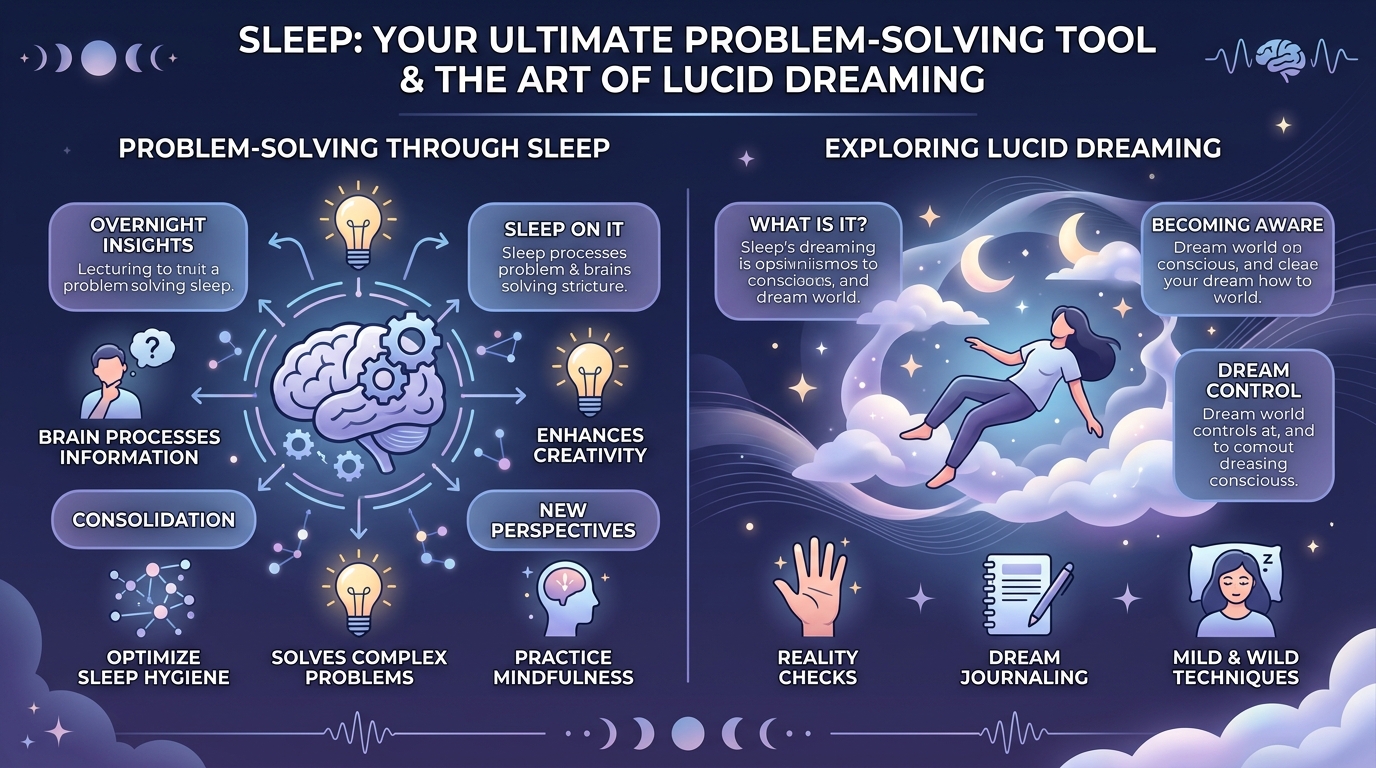
The Science of Dream Engineering
Cognitive neuroscientist Karen Konkoly and her team at Northwestern University wanted to see if they could influence the dreams of “lucid dreamers” (people who are aware they are dreaming and can alter the dream’s course).
They gave participants brain-teasing puzzles. For the puzzles the participants could not solve, the researchers played a specific soundtrack (like a soft piano chord) while they were working on it. Later that night, while the participants were in REM sleep (the stage associated with creative thinking), the researchers quietly played those exact same sound cues.
This technique, called Targeted Memory Reactivation (TMR), nudged the sleeping brain to dream about the unsolved puzzles. The results were astounding: sleepers who heard the sound cues and dreamed about the puzzles successfully solved them 42% of the time the next morning, compared to only 17% for those who didn’t.
OmOrenda Concepts: Using Yoga Nidra to Tap Into the Subconscious
While the Northwestern study focused on lucid dreaming and sound cues, the underlying mechanism—accessing the subconscious to rewrite neural pathways and solve problems—is a core pillar of OmOrenda.space.
You don’t need to be hooked up to electrodes in a sleep lab to harness this power. The ancient practice of Yoga Nidra (Non-Sleep Deep Rest) achieves a remarkably similar state.
Yoga Nidra systematically guides the brain through the exact same brainwave states experienced during sleep (from active Beta, down to creative Alpha, dreamy Theta, and regenerative Delta), all while maintaining a sliver of waking consciousness.
How Remote Workers Can Use This
In our previous article about the mental health crisis of remote work, we discussed how the lack of boundaries causes immense burnout and cognitive fatigue. When you are stuck on a work problem in your home office, staring harder at the screen only depletes your prefrontal cortex.
Instead of forcing a solution, remote workers can use the OmOrenda protocol:
- Set an Intention (Sankalpa): Before beginning a 20-minute Yoga Nidra session, bring the unsolved work problem to mind. Ask your subconscious to process it.
- Enter the Theta State: Follow the Yoga Nidra body scan. As your brainwaves slow down into the Theta state (the doorway to REM and dreaming), your brain’s default mode network takes over. This network connects disparate ideas and forms novel, creative associations that your stressed waking mind cannot see.
- Emerge with Clarity: Just like the participants in the dream study, you will often emerge from the Yoga Nidra state with a sudden “Aha!” moment or a fresh perspective on the problem.
Valuing the Inner Life
As Konkoly notes in her research, the goal isn’t just to “corrupt our dreams for productivity.” It is to realize that our inner, resting lives have immense value. By prioritizing high-quality sleep and integrating practices like Yoga Nidra, we aren’t just escaping our daily problems—we are actively building the neurological tools required to overcome them.
For more reading on the science of sleep and problem-solving, check out the original Science News article here.