

The Surprising Science-Backed Reasons Your Brain Craves Nature
For a long time, science explained nature’s benefits through simple, practical lenses: fresh air, vitamin D from sunlight, or just getting away from our stressful desks. But recent breakthroughs point to a much deeper, more unexpected reason why our brains crave natural settings.
The “surprising science-backed reason” is part of an incredibly fascinating shift in how neurologists and psychologists study the great outdoors. Three surprising, science-backed elements explain exactly why stepping into nature feels like an immediate mental reset.
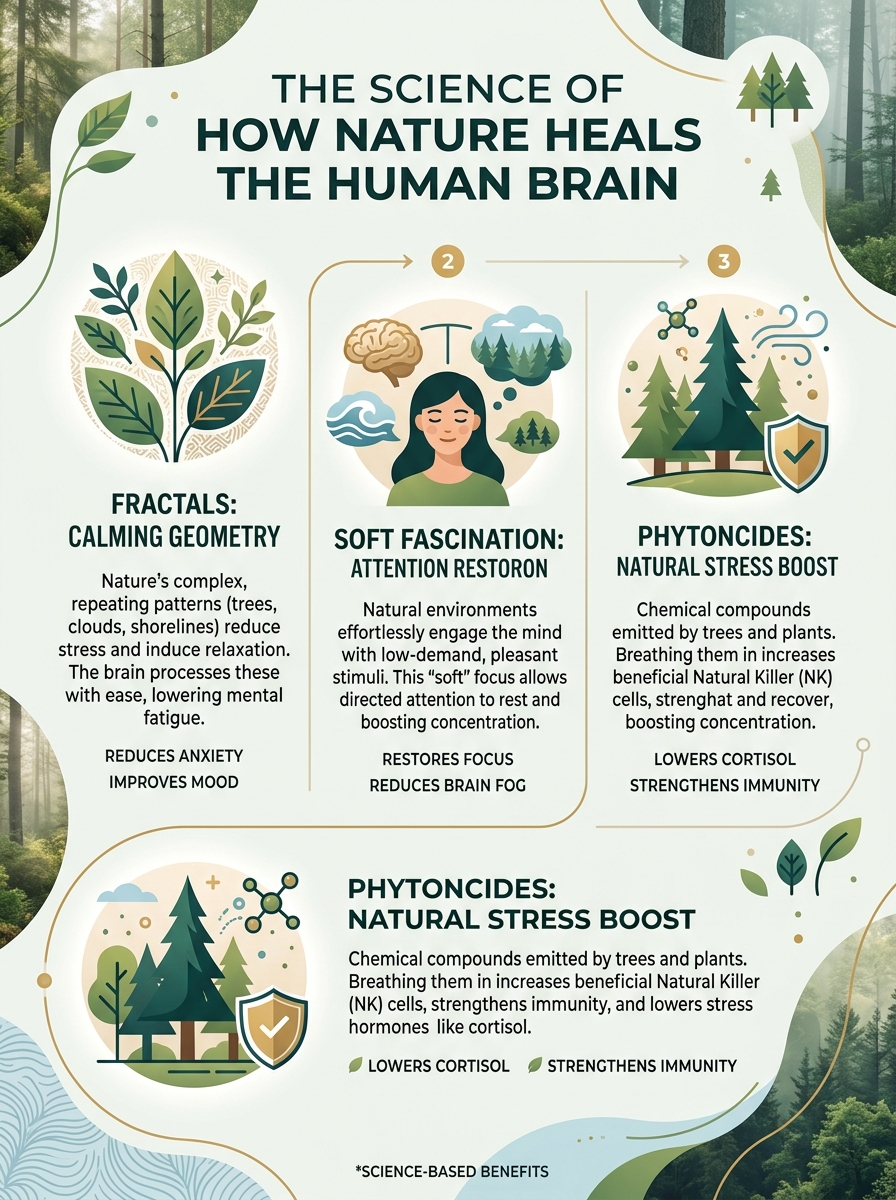
1. Your Brain Craves “Fractals” (Nature’s Secret Geometry)
One of the most surprising reasons nature calms us comes down to geometry. Man-made environments are dominated by harsh, straight lines and sharp 90-degree angles (think of buildings, streets, and phone screens).
Nature, however, is made of fractals—repeating self-similar geometric patterns found in things like the veins of a leaf, the branches of a tree, or the ridges of a mountain.
The Science: Physicists and neuroscientists have found that the human visual cortex can process fractal patterns with incredible ease. When your eyes look at a tree or a cloud formation, it requires significantly less cognitive effort. This instantly triggers a physiological relaxation response, lowering stress levels by up to 60% just by looking at them.
2. “Soft Fascination” Resets Mental Fatigue
In a city or office setting, you are constantly using directed attention. You have to force yourself to ignore distractions, focus on a screen, dodge traffic, or read signs. This actively drains your prefrontal cortex, leading to irritability and “brain fry.”
The Science: Psychologists refer to nature’s pull as soft fascination. The movement of leaves in the wind, a bird darting across the sky, or water rippling over rocks catches your attention involuntarily and gently. Because it requires zero conscious effort to process, it gives your brain’s overtaxed focus center a chance to fully recharge and repair.
3. Breathing in “Phytoncides” (The Tree Immune System)
It turns out the benefits of walking in the woods aren’t just visual—they are airborne.
The Science: Plants and trees secrete antimicrobial organic compounds called phytoncides to protect themselves from insects and rotting. When we spend time in forests and breathe these in, our bodies respond by ramping up the production of a type of white blood cell called “Natural Killer” (NK) cells. These cells actively lower our heart rates, decrease cortisol (the primary stress hormone), and boost our immune systems for days after a walk.
Essentially, we didn’t just evolve to like nature; our neurological and biological systems were literally engineered to function in tandem with it. When we step away from screens and into green spaces, we aren’t just relaxing—we are returning our brains to their default operating system.