

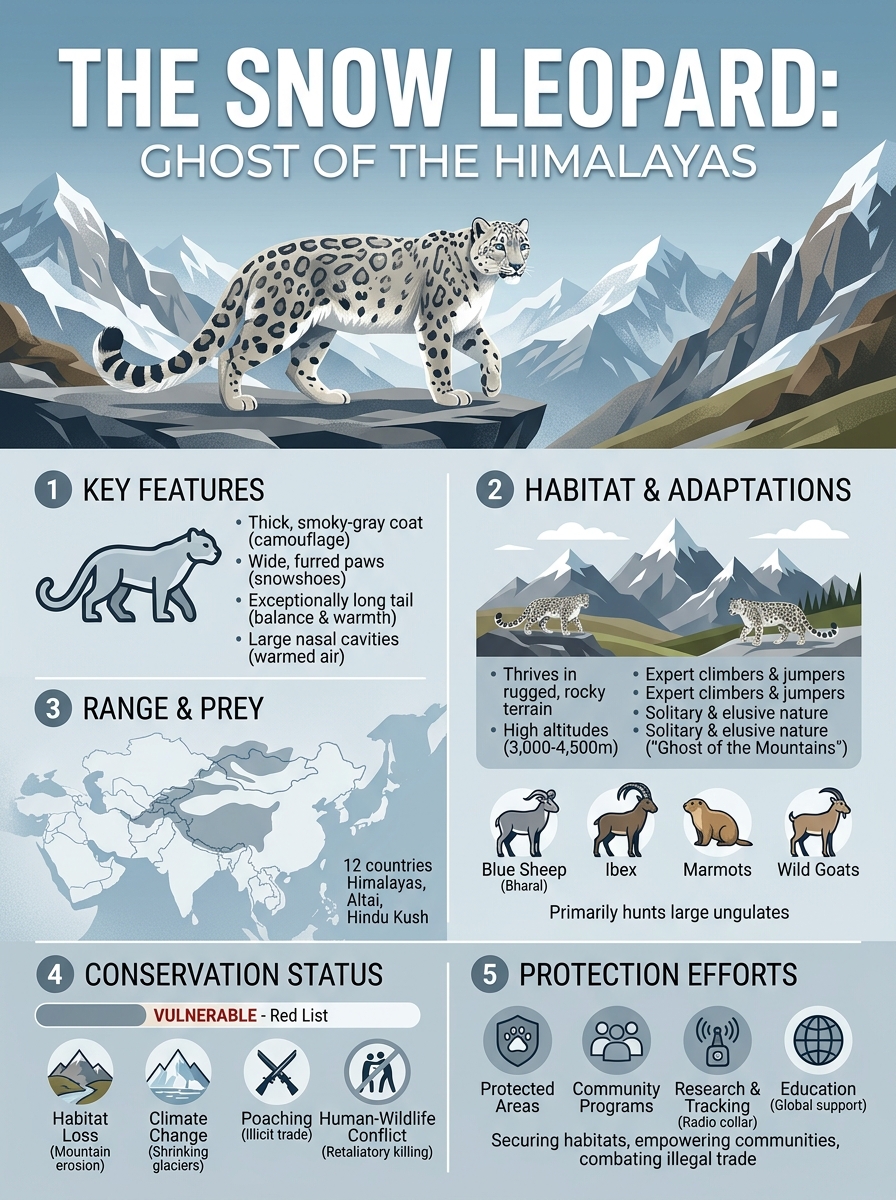
Ghost of the Himalayas: Tracking the Elusive Snow Leopard
Before dawn fully breaks over the rugged Ulley Valley in Ladakh, a quiet whisper travels faster than light across ridgelines and river bends: a snow leopard has been spotted. Within minutes, vehicles are readied, naturalists gather their guests, and the pursuit of one of the world’s most elusive creatures begins.
The drive unfolds across a terrain that is both immense and intimate. Snow begins to fall, blurring the edges of the mountains. But by the time the convoy reaches the spot, the mountains have settled back into stillness. The mother snow leopard and her cubs, glimpsed just an hour earlier, have dissolved back into the landscape.
They are called the “Ghost of the Mountain” for a reason.
A Fragile Balance
At the heart of Ulley’s reputation as one of the world’s most reliable snow leopard habitats is an intricate, deeply local human network. Spotters and trackers armed with high-powered scopes scan the cliffs from early morning until dusk for six months of the year. But the true story of Ulley isn’t just about spotting these elusive cats; it’s about a fragile balance struck between people, prey, and predator.
For generations, the Ladakhi communities have depended heavily on livestock. A single predation event—a snow leopard entering a poorly secured pen—could completely devastate a family’s livelihood. In the past, this led to retaliation. But thanks to conservancy efforts, the narrative has shifted.
“Traditionally, livestock pens were open at the top,” explains Surya Ramachandran, a conservationist working in Ulley. “With support from the conservancy, villagers began reinforcing these pens with wire mesh and proper roofing.”
Conservation Through Community
The results of these simple structural changes have been monumental. Retaliation against snow leopards has dropped by nearly 95%. But the shift is perceptual as much as it is economic.
Tourism has changed everything. Wildlife is no longer viewed as a threat, but as a source of income. Locals now host guests and work as trackers and guides. Conservation is no longer something imposed by outsiders; it is wholly owned by the community.
As dusk settles over the valley and the ridgelines fade into the icy blue night, the occasional absence of a sighting doesn’t feel like a failure to those tracking them. Instead, it reinforces the quiet truth of this landscape: the snow leopard’s greatest power lies in its sheer invisibility.
In that invisibility, a new story has taken root—one where survival for both people and predators is no longer a zero-sum game.