

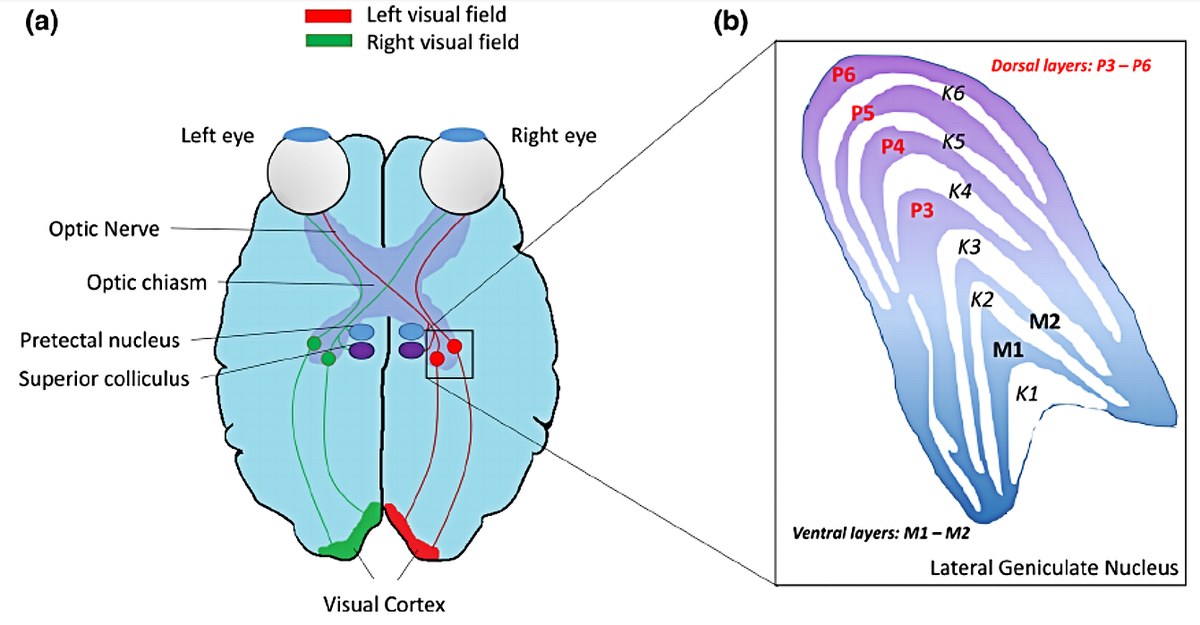
The human visual pathway: nerve fibers cross at the optic chiasm, establishing the ancient contralateral blueprint that governs vertebrate nervous systems.
Why does the left hemisphere of your brain control the right hand, while the right hemisphere moves the left? Why does a touch on your left shoulder register in the somatosensory cortex of your right brain?
For centuries, the phenomenon of decussation: the mysterious cross wiring of the central nervous system: has puzzled anatomists, evolutionary biologists, and philosophers alike. It has long seemed like an inefficient paradox. Why would nature require nerve fibers to journey across the midline of the body, creating vulnerabilities to stroke and spinal trauma, rather than simply wiring each side directly?
In a groundbreaking evolutionary investigation published in Frontiers in Neuroanatomy and reported by ScienceDaily, neuroscientists Dr. Martin Wessendorf and Daniel Wang from the University of Minnesota propose an elegant answer. The brain’s crossed architecture is not necessarily an optimized adaptation for limb control. Instead, it is a living biological legacy: a 500 million year old inheritance rooted in the visual systems of the earliest Cambrian fish.
The Optical Inversion Origin: Where It All Began
The evolutionary mystery begins with the physics of light. When light passes through a convex optical lens, the projected image is inverted both vertically and horizontally. An object appearing in the animal’s right visual field casts light onto the left retina, while objects on the left strike the right retina.
To interpret this inverted sensory stream, the earliest vertebrate ancestors (primitive jawless fish during the Cambrian Period, over five hundred million years ago) developed a specialized crossing junction: the optic chiasm. Nerve fibers originating from the nasal retina crossed the midline to project information from the right visual field directly into the left side of an ancient midbrain structure called the optic tectum (known in mammals as the superior colliculus).
The optic tectum is one of the oldest neural structures in vertebrate biology. Inside its layers, nature established an internal topographic map of the outside world, mapped to the opposite side of the brain.
1. Optical Inversion Foundation
Light entering ancient fish lenses projected an inverted image onto retinas. The optic chiasm evolved to route opposite visual fields to the optic tectum over 500 million years ago.
2. Sensory and Motor Alignment
To orient toward visual stimuli, sensory and escape motor circuits (tectospinal and spinothalamic pathways) crossed the midline to coordinate with visual tectal maps.
3. Mammalian Cortical Inheritance
Rather than rewiring the nervous system from scratch, emerging neocortical pathways (corticospinal and rubrospinal tracts) built directly upon this ancient crossed scaffold.
Aligning Sensation and Movement: The Great Cascade
Once the ancient midbrain visual map was cross wired, every other sensory and motor system had to fall into alignment to ensure survival. If an ancient predator appeared on the right, the visual signal arrived in the left optic tectum. To turn rapidly toward or away from the threat, the motor commands had to cross the midline back to the right side of the body.
This necessity spawned the tectospinal tract: an ancient motor pathway that originates in the deepest layers of the optic tectum, crosses the midbrain midline, and travels down the spinal cord to trigger reflexive head and body turns. To coordinate escape, somatosensory pathways carrying touch and proprioception (the dorsal column pathway and the spinothalamic tract) likewise evolved crossed trajectories to align with the visual tectal map.
As life crawled from ancient oceans onto land, early four limbed tetrapods did not reinvent their nervous systems from scratch. Evolution is a master tinkerer, building new functions on top of ancient scaffolding. When mammals and primates subsequently evolved advanced cerebral cortices for fine motor dexterity, the new pathways (such as the corticospinal tract) simply inherited and followed the established contralateral highways.
Evolutionary Heritage Over Teleological Design
This discovery provides a profound lesson in evolutionary biology. In Western scientific thought, researchers often assume that every biological feature must exist because it confers a direct functional advantage (a perspective known as adaptationism). People frequently theorized that crossed wiring prevented electromagnetic interference between hemispheres or provided geometric advantages for limb coordination.
Wessendorf and Wang demonstrate that crossed wiring may simply be an architectural inheritance. Because the visual system established a contralateral blueprint in jawless fish 500 million years ago, all subsequent vertebrate neural developments were constrained to build upon that foundation. Our human ability to play a piano, write poetry, or shape stone with our fingers relies on pathways inherited from ancient marine ancestors who needed to dodge predators in the Cambrian seas.
The OmOrenda Perspective: The Living Ocean Within Us
This neurological revelation resonates deeply with the core philosophy of OmOrenda, bridging contemplative stillness with ecological kinship:
The Living Continuity of Om
In Eastern contemplative traditions, Om represents the unbroken continuity of existence. We often imagine ourselves as separate from nature: modern minds operating in artificial environments. Yet neuroscience reveals that our physical brain is an ancient biological archive. When you move your fingers or look across a horizon, you are enacting a dance of neurons established hundreds of millions of years before humans existed. We carry the ocean within our nervous systems.
The Kinship of Orenda Across Deep Time
Orenda teaches that life energy flows through all living beings in reciprocal relationship. Recognizing that our highest cognitive and motor faculties are rooted in ancient fish lineages dissolves human arrogance. We are not isolated masters of nature; we are evolutionary kin to every creature that swims, crawls, or flies. This realization deepens our responsibility to act as loving caretakers for the biosphere.
Embodied Wholeness: Moving Beyond Duality
The cross wiring of our brain reminds us that left and right, sensory input and motor action, mind and body, are not separate compartments. They are unified in a continuous, reciprocating loop of awareness. In somatic practices like Yoga Nidra, mindful breathing, and forest bathing, we honor this deep ancestral wiring: dropping cognitive fragmentation to return to the natural harmony of our embodied living state.
References and Sources
- Frontiers in Neuroanatomy (2026). Decussation and the Evolutionary Origins of Contralateral Pathways in the Vertebrate Central Nervous System.
- ScienceDaily, Scientists may have finally explained why our brains and bodies are cross wired, November 4, 2026.
- University of Minnesota, Department of Neuroscience, Dr. Martin Wessendorf and Daniel Wang Research Archive.