

The Science of Stillness: Medical Students Turn to Sound Healing
As the pressures of modern life—and rigorous academic pursuits—continue to mount, a fascinating convergence is happening in Pittsburgh. At the intersection of prestigious medical programs and centuries-old Eastern traditions, students and researchers are exploring the tangible, clinical benefits of sound healing.
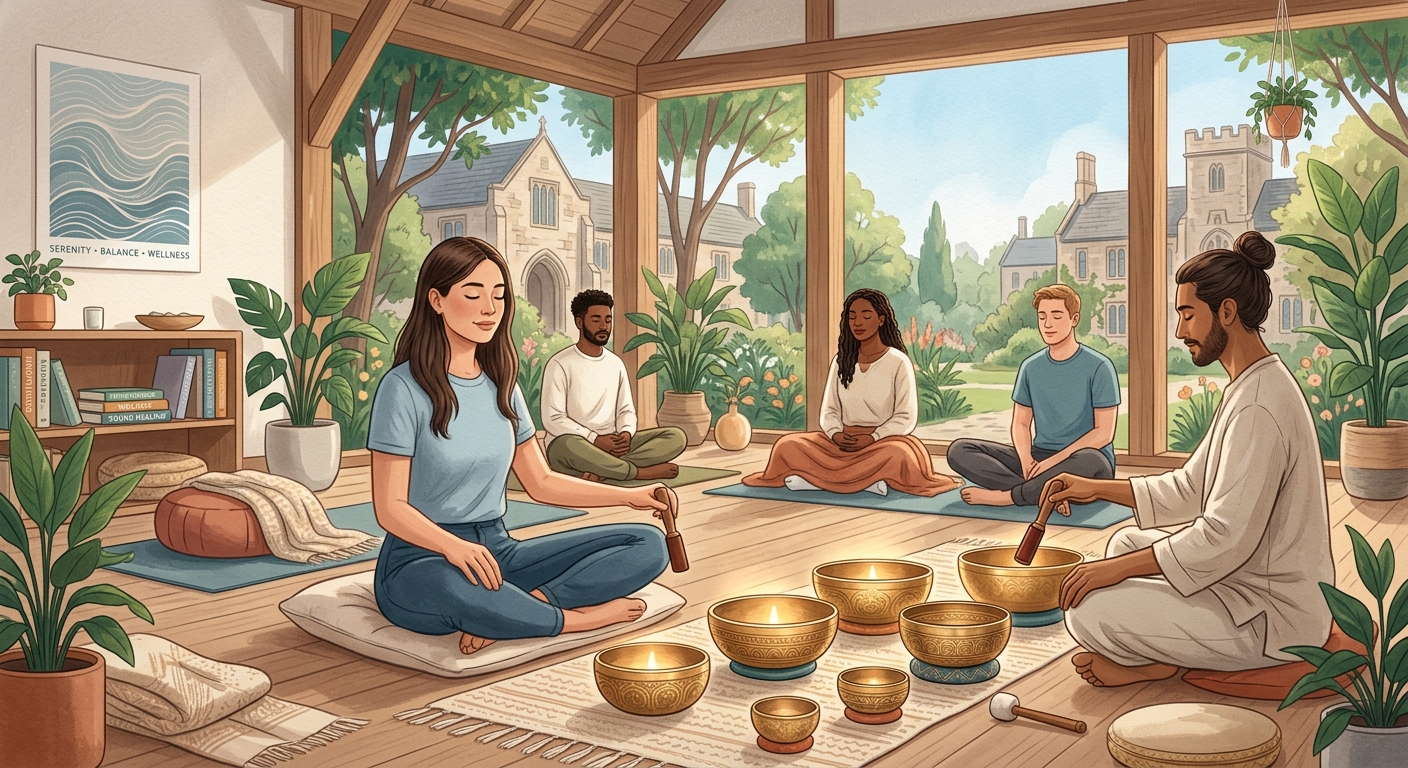
Recent initiatives at the University of Pittsburgh and Carnegie Mellon University (CMU) are bringing “sound baths” out of wellness studios and directly into the academic and medical curriculum. Led by Monique Mead, a world-renowned violinist and CMU professor, these sessions utilize violins, gongs, and crystal singing bowls to guide participants into deep states of restorative relaxation.
More Than Just Relaxation: The Mechanics of Entrainment
While lying in a blanketed bean bag listening to overlapping, undulating tones sounds undeniably pleasant, there is profound biology at work. The core mechanism behind sound healing is entrainment—a physics phenomenon where our biological rhythms (like heart rate and brainwaves) synchronize to external, rhythmic pulses.
Similar to how a clinical music therapist might use a slow drumbeat to calm a racing heartbeat in an ICU, the harmonic vibrations of singing bowls help the body shift from the stress-driven sympathetic nervous system into the parasympathetic “rest and digest” mode. In this state, distractions fade, and the body does what it is naturally built to do: repair tissue and find balance.
Bridging the Gap: From Anecdote to Empirical Data
At Omorenda, we believe in the synergy of ancient wisdom and modern technology for human flourishing. This is precisely what is unfolding at Pitt. Jessica Burke, a professor at Pitt’s School of Public Health, is leading a parallel research element alongside the sound healing course to provide hard scientific data on its effectiveness.
Preliminary surveys from CMU’s “Scottie Sound Bath” program are already showing striking results: while 79% of respondents reported feeling anxious before a session, that number plummeted to just 20% afterward. The next phase of research will look even deeper, measuring biometric markers like heart rate longevity of effects, moving sound healing from the realm of “alternative” to a documented, evidence-based clinical tool.
The Future of Clinical Care
Medical students are recognizing the vast potential of these passive relaxation techniques for clinical settings. For patients confined to hospital beds or experiencing severe pain where physical movement is limited, sound therapy offers a non-invasive pathway to ease anxiety and promote somatic healing.
Therapists and counselors are also integrating these methods into their practices, noting that when patients arrive in a state of deep, resonant calm, the psychological work of therapy is vastly accelerated.
As we continue to build a future where humans truly flourish, embracing the ancient frequencies of the universe—and measuring them with the rigor of modern science—reminds us that healing is both an art and a quantifiable science.