

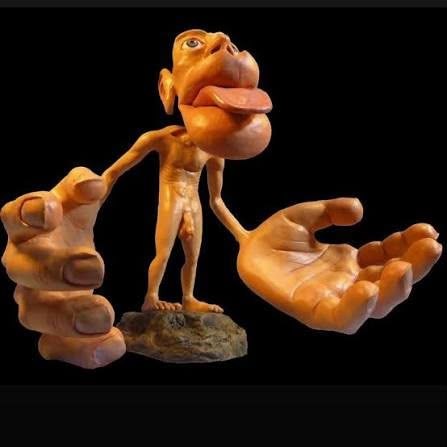
Credit: 3D Sensory Homunculus model based on the neural mapping of Dr. Wilder Penfield & Theodore Rasmussen (Montreal Neurological Institute). Exhibit on display at the Natural History Museum, London.
If you were to redraw the human body not by its physical proportions, but by how much space your brain dedicates to sensing and controlling each body part, what would you look like?
You wouldn’t look like Leonardo da Vinci’s Vitruvian Man. You would look like a bizarre, alien-like creature with gigantic hands, enormous lips, a massive tongue, an oversized jaw, and a comically tiny torso and legs.
In neuroscience, this physical sculpture is known as the Cortical Homunculus (literally, “little man” in Latin). First mapped in the 1930s by pioneering Canadian neurosurgeon Dr. Wilder Penfield and Theodore Rasmussen, this biological map reveals how our cerebral cortex experiences the physical world—and provides profound clues for stress relief, speech, and somatic relaxation.
1. What Is the Cortical Homunculus?
When Dr. Penfield operated on awake patients undergoing brain surgery for severe epilepsy, he used mild electrical stimulation on the surface of the cerebral cortex to map which areas controlled specific body parts.
He discovered two adjacent, highly organized maps across the brain’s folded surface:
- The Primary Motor Cortex (Precentral Gyrus): Directs voluntary muscle movement and physical dexterity.
- The Primary Somatosensory Cortex (Postcentral Gyrus): Receives tactile sensations (touch, pressure, temperature, pain, and proprioception).
The key takeaway: Brain space is not allocated by square inches of skin, but by the density of nerve endings and functional importance for survival.
2. Why Is the Jaw So Enormously Big on the Homunculus?
When looking at the Homunculus model, one of the most striking features is the gargantuan jaw, lips, and mandible. Why did human evolution allocate so much precious neural territory to our jaw while shrinking our back and legs?
The answer comes down to three critical evolutionary mechanisms:
I. The High-Stakes Physics of Chewing (Mastication & Bite Force)
The human jaw is capable of generating extraordinary bite forces—often between 150 to over 200 pounds of pressure per square inch via the powerful masseter and temporalis muscles.
To prevent us from cracking our own teeth, biting through our cheeks, or choking on un-chewed food, the jaw, gums, and teeth are packed with thousands of high-precision periodontal mechanoreceptors. Your brain requires massive computing bandwidth to constantly calculate micron-level bite adjustments in real time as food textures shift from hard to soft.
II. Speech, Language Articulation & Fine Motor Precision
Humans are the only species on Earth with complex verbal language. Speaking requires sub-millisecond coordination between the jaw (mandible), tongue, palate, and vocal cords:
- Every syllable you utter requires rapid, microscopic adjustments of jaw elevation, depression, and lateral movement.
- Without a massive dedicated motor cortex region for the jaw and mouth, the delicate consonants and vowels of human language would degrade into slurred, incomprehensible mumbles.
III. The Trigeminal Highway & Emotional Stress Shield
The jaw and face are directly wired by the Trigeminal Nerve (Cranial Nerve V)—the largest and most powerful cranial nerve in the human head.
Evolutionarily, the jaw is a primary somatic shield:
- In moments of threat, anger, or acute stress, the sympathetic nervous system triggers the primal bite-and-clench reflex (temporomandibular tension).
- Because the jaw has such a direct line into the brainstem and limbic fear centers, chronic psychological stress almost always manifests as jaw clenching (bruxism) and TMJ tightness.
3. The Homunculus as a Shortcut to Somatic Healing & Yoga Nidra
Understanding the Cortical Homunculus transforms how we approach stress reduction, mindfulness, and somatic body scanning.
In practices like Yoga Nidra (Rotation of Consciousness), the guided meditation systematically leads your attention through a very specific sequence: the right thumb, the index finger, the palm, the corners of the lips, the tongue, and the jaw.
The Neurological Shortcut:
- Relaxing the Thumbs & Palms: De-excites ~30% of the sensory cortex.
- Unclenching the Jaw, Lips & Tongue: De-excites another ~30% of the motor and sensory cortex.
- Result: Over 60% of your total cortical activity is quieted without moving a single muscle.
By simply releasing your jaw, resting your tongue on the floor of your mouth, and softening your hands, you send an immediate, bottom-up signal through the vagus and trigeminal nerves that the environment is safe—switching off fight-or-flight and plunging your nervous system into restorative parasympathetic peace.
4. The 30-Second “Homunculus Reset” Protocol
Whenever you feel overwhelmed, anxious, or mentally fatigued during a workday, try this 30-second reset targeting your brain’s largest mapped regions:
- Drop the Mandible: Allow your teeth to part slightly, letting your lower jaw hang loose and heavy.
- Release the Tongue: Let your tongue drop away from the roof of your mouth, softening your throat.
- Open the Palms: Uncurl your fingers, resting your hands flat and heavy on your lap or desk.
- Take a Slow Physiological Sigh: Inhale deeply through your nose, take a short second sip of air at the top, and exhale fully through an open mouth.
The Takeaway
The Cortical Homunculus reveals the hidden geometry of human consciousness. We are creatures sculpted for touch, speech, connection, and survival.
The next time you catch yourself clenching your jaw or furrowing your brow, remember the giant little man inside your head. By giving your jaw and hands permission to soften, you liberate your brain to rest, heal, and thrive.
Credits & References
- Scientific Foundation: Neural homunculus mapping established by Dr. Wilder Penfield and Dr. Theodore Rasmussen in The Cerebral Cortex of Man (Macmillan, 1950).
- Sculptural 3D Model: Sensory Homunculus 3D sculpture by Sharon Price-James, exhibited at the Natural History Museum, London / Wellcome Collection.