
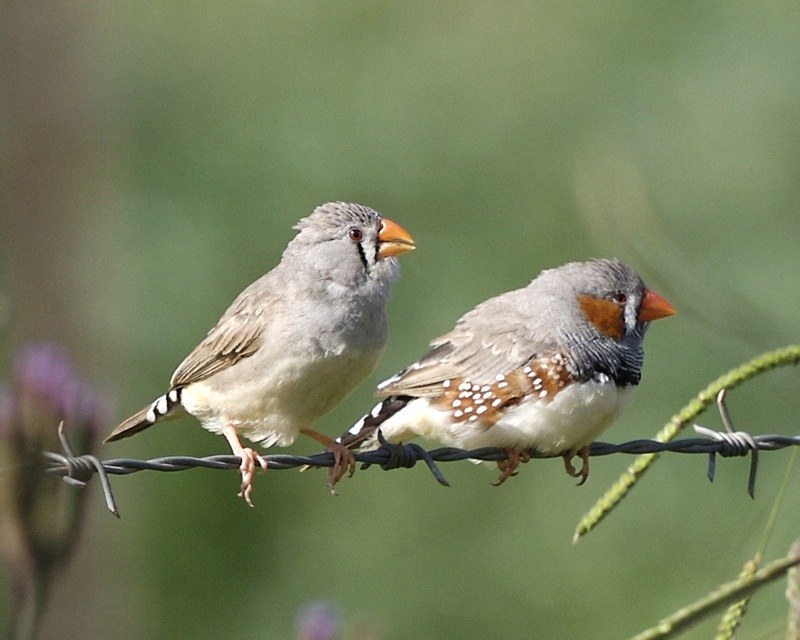
Photo by Lip Kee Yap on Wikimedia Commons (CC BY SA 2.0): A mated pair of zebra finches, the species whose complex vocal repertoire is bridging the frontier of interspecies communication.
For thousands of years, humans have listened to birdsong with wonder, regarding it as pleasant ambient music: the morning chorus greeting dawn or the evening melody closing dusk. We assumed that human speech was a solitary fortress on this planet, while avian sounds were relegated to mechanical mating displays and instinctual alarm chirps.
That ancient divide is crumbling under the lens of modern computational neuroethology. In a fascinating interview with Live Science, Dr. Julie Elie, an animal behavior scientist at the University of California, Berkeley, revealed how her team utilized machine learning and behavioral experiments to decode the vocal language of zebra finches. Winner of the prestigious 2026 Coller Dolittle Challenge for Two Way Interspecies Communication, Dr. Elie arrived at a breathtaking conclusion: the first non human species with which humanity will establish two way vocal communication may well be a bird.
When examined through the salutogenic philosophy of OmOrenda, this breakthrough is not merely a triumph of artificial intelligence; it is a profound philosophical awakening. It invites humanity to shed Cartesian arrogance, step into contemplative stillness, and recognize that we share our living world with conscious, eloquent minds.
The Lifelong Pair Bond: Rethinking Avian Society
Dr. Julie Elie’s journey into avian linguistics began with a surprising discovery about animal social dynamics. Conventional ethology previously assumed that small birds operate under strict dominance hierarchies or territorial peck orders. Yet when Dr. Elie observed zebra finches over years of intimate study, she noticed that hierarchy was virtually nonexistent.
Instead, the true nucleus of zebra finch society is the lifelong monogamous pair bond. Males and females pair for life, coordinating foraging, nest building, and predator vigilance through continuous vocal dialogue. Their vocalizations are not territorial shouts, but ongoing conversational check ins that sustain intimacy, coordinate movement, and reaffirm mutual trust.
This relational foundation makes birds remarkably talkative. Unlike mammals that communicate primarily through scent marking or subtle posturing, birds rely heavily on rich acoustic bandwidth, making them the ideal partners for early cross species communication.
The Breakthrough: Proving Birds Understand Semantic Meaning
How do scientists know whether an animal sound is a genuine word rather than a random noise?
To solve this challenge, Dr. Elie constructed an acoustic dictionary of zebra finch call types, pairing specific social contexts with precise acoustic waveforms. However, proving that the birds themselves perceived these categories required asking the birds directly:
1. Acoustic Repertoire Mapping
Cataloging thousands of natural calls across distinct social settings to build the first functional vocal dictionary of zebra finch sound types.
2. Operant Verification by the Birds
Presenting recorded calls to the birds themselves; rewarding specific call types to mathematically verify whether avian brains classify them as distinct words.
3. Semantic Similarity Discovery
Analyzing rare classification mistakes to prove errors stem from underlying semantic meaning rather than mere acoustic pitch or sound likeness.
The team designed an operant conditioning game where a bird could peck an infrared sensor to trigger a randomly selected call recording from their vocal library. On any given day, only one specific call type yielded food seeds, while other calls yielded nothing. The birds could skip non rewarded sounds at will, much like skipping tracks on a music playlist.
Within minutes, the zebra finches learned the rule of the day, skipping irrelevant calls and pausing only on the rewarded call type. The birds mathematically validated Dr. Elie’s vocal dictionary. But the most profound discovery lay in their mistakes:
- Acoustic Versus Semantic Errors: In human speech, an acoustic mistake is confusing “glove” with “love” or “hurt” with “heart” because the sounds resemble one another. A semantic mistake is confusing “love” with “heart” because both words share a conceptual meaning.
- Avian Semantic Cognition: Dr. Elie’s analysis revealed that the birds’ rare classification errors were driven by semantic similarity rather than acoustic pitch likeness. The finches were organizing and grouping calls based on shared conceptual meaning.
This provides compelling evidence that avian brains process vocalizations as meaningful symbolic representations, shattering the claim that symbolic thought is unique to humans.
The 10 Year Horizon: Multimodal Interspecies Dialogue
Dr. Elie emphasizes that genuine communication will not arrive overnight. Achieving authentic dialogue requires decoding the full syntax and multimodal dimensions of bird communication:
- Combinatorial Syntax: Understanding how individual calls are strung together into complex sequences to alter meaning.
- Temporal Dynamic Rules: Decoding the subtle conversational pacing, response latencies, and conversational turn taking that govern avian exchanges.
- Multimodal Physical Displays: Incorporating body postures, wing flutters, and visual displays that accompany vocalizations.
With rapid advancements in computer vision, bioacoustic robotics, and empathetic machine learning, Dr. Elie anticipates that meaningful two way vocal interaction with birds will be achievable within the next ten years.
The OmOrenda Perspective: Restoring the Sacred Council of All Beings
The realization that birds possess rich, semantic inner worlds aligns completely with the foundational tenets of OmOrenda:
The Attunement of Om (Listening to the Living Chorus)
In Eastern contemplative philosophy, Om represents the primordial vibration and seamless continuity of all life. For centuries, modern urban civilization has operated in noisy isolation, tuning out the natural soundscape. Stepping into the stillness of Om means learning how to listen once again. When we sit in quietude beneath the canopy, birdsong ceases to be empty background noise; it reveals itself as a vibrant, conscious conversation unfolding all around us.
The Living Kinship of Orenda (The Council of All Beings)
In Indigenous Haudenosaunee cosmology, Orenda is the spiritual life energy uniting all conscious creatures. Indigenous traditions speak of an ancient time when humans sat in council with animals, understanding the speech of our winged and four legged kin. Clan Mothers taught that true wisdom requires humility: recognizing that other creatures possess sovereign agency, emotional lives, and ancestral intelligence. As Dr. Elie noted, the primary lesson of this research is that humans are not the only intelligent beings on this planet, and we must begin treating our planetary kin with profound reverence and ethical care.
Ethical AI as a Bridge of Compassion
At OmOrenda, we advocate for raising artificial intelligence not as an instrument of surveillance or battlefield destruction, but as an ethical tool for planetary healing and interspecies kinship. Deploying machine learning to translate birdsong and protect fragile habitats fulfills the highest calling of technology: bridging consciousness, healing human alienation, and fostering universal flourishing.
References and Further Reading
- Kenna Hughes Castleberry, The first species we might be able to communicate with might be a bird: An animal researcher explains how she decoded birdsong, Live Science, November 2026.
- Dr. Julie Elie, Computational Neuroethology and Avian Vocal Communication Research Laboratory, University of California, Berkeley.
- The Coller Dolittle Challenge for Two Way Interspecies Communication, 2026 Award Archive.