
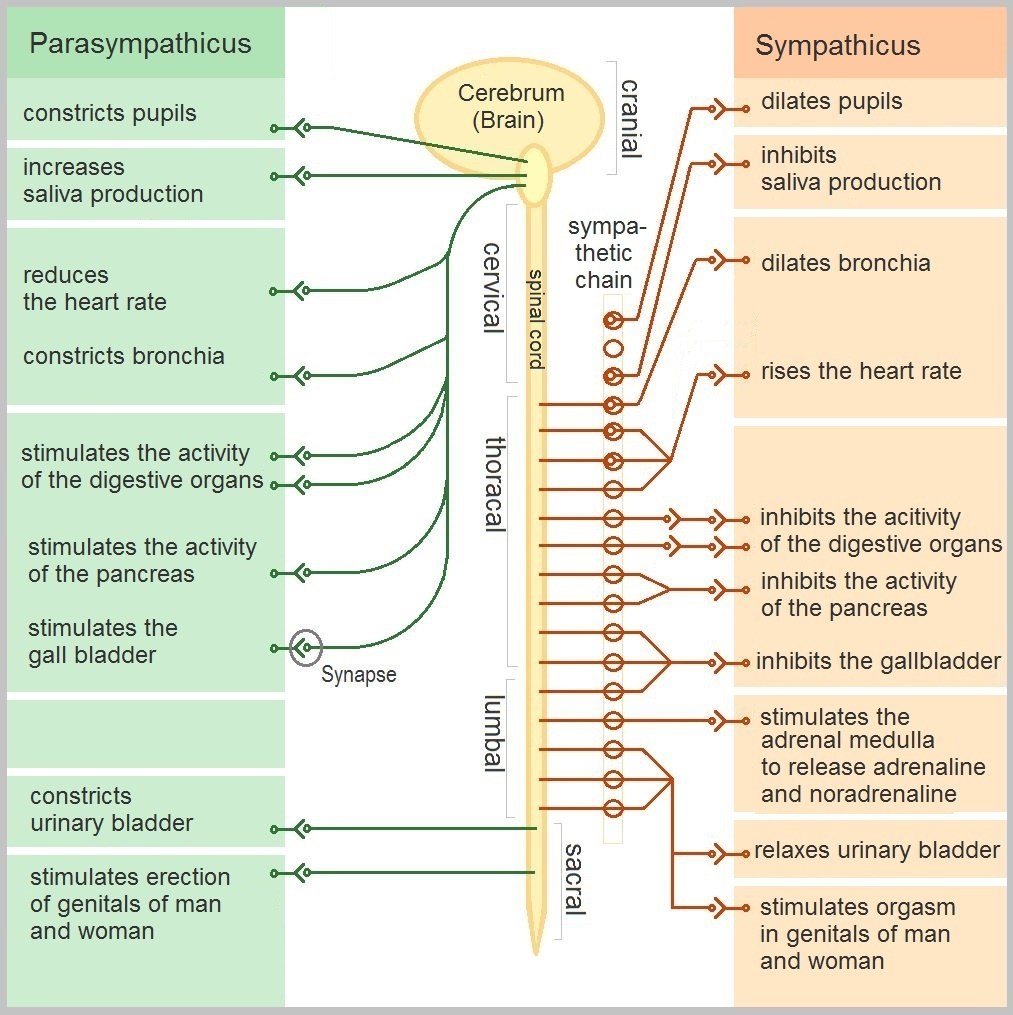
Public domain medical diagram by Geo Science International: The autonomic nervous system, showing the dynamic interplay between sympathetic activation and parasympathetic vagal recovery across every major organ.
In our fast paced modern culture, relaxation is often misunderstood as a passive, motionless state: lying completely still on a sofa, trying to empty the mind of thoughts, or forcing yourself to feel calm. Yet when we examine the human body through the lens of neuroscience and clinical physiology, true wellness is not about staying frozen in permanent relaxation.
Instead, genuine health is defined by nervous system regulation: the biological capacity to flexibly shift into states of high energy, alertness, or action when life demands it, and then smoothly, effortlessly return to a calm baseline equilibrium once the challenge passes.
When our nervous system loses this natural elasticity, we become stuck. We either stay trapped in chronic anxiety and racing thoughts (sympathetic overdrive), or we collapse into numbness, exhaustion, and brain fog (dorsal shutdown). Drawing upon foundational clinical frameworks: from Dr. Stephen Porges’ Polyvagal Theory to Dr. Bessel van der Kolk’s research on somatic trauma: we can understand how our autonomic wiring operates, and how simple daily practices restore our natural vitality.
The Architecture: Autonomic Branches and Polyvagal States
The Autonomic Nervous System (ANS) manages our heart rate, breathing, digestion, and immune defenses silently beneath conscious thought. Remarkably, science shows that communication along the primary superhighway of this system: the tenth cranial nerve, known as the vagus nerve: is largely a one way conversation from the body up to the brain. Roughly eighty percent of vagus nerve fibers are afferent, sending continuous sensory updates from our gut, lungs, and heart up to the brainstem, while only twenty percent carry instructions downward.
In his landmark book The Polyvagal Theory, neuroscientist Dr. Stephen Porges revealed that our autonomic nervous system evolved through three distinct evolutionary stages, creating a hierarchy of responses to the world around us:
1. Ventral Vagal State
Social Safety: Myelinated vagus nerve acts as a gentle brake on heart rate, fostering open curiosity, warm vocal tones, and calm presence.
2. Sympathetic Mobilization
Action and Alertness: Adrenaline and noradrenaline elevate heart rate, dilate pupils, and prepare the body for focused effort or protection.
3. Dorsal Vagal State
Immobilization: Unmyelinated primitive pathways governing deep visceral rest, or in acute overwhelm, metabolic shutdown and numbing.
- 1. Ventral Vagal State (Safety and Social Connection): This is our newest evolutionary branch, wrapped in a protective myelin sheath. It innervates the heart, lungs, facial muscles, and middle ear. When this pathway is active, it functions as a biological vagal brake, gently slowing our pulse. We feel safe, curious, creative, and socially connected. Our eyes soften, our voice becomes expressive, and our digestion hums along peacefully.
- 2. Sympathetic Nervous System (Mobilization and Action): When our subconscious senses a challenge or threat: through a process Dr. Porges terms neuroception: the vagal brake releases. The adrenal glands release adrenaline and noradrenaline. Heart rate accelerates, pupils dilate, and blood rushes to large skeletal muscles. This state is essential for healthy exercise, focused work, and protecting ourselves. Problems arise only when we remain stuck in this emergency state for weeks or months.
- 3. Dorsal Vagal State (Immobilization and Conservation): The most primitive branch, consisting of unmyelinated nerve fibers originating deep in the brainstem. In healthy states, dorsal pathways quietly coordinate resting digestion. However, under overwhelming or prolonged trauma, it triggers a protective freeze response. Heart rate plummets, muscles lose tone, and the brain experiences emotional numbness or dissociation.
Two Pathways of Healing: Bottom Up versus Top Down
When you feel overwhelmed by anxiety or panic, has anyone ever told you: “Just calm down and think positive thoughts”? If so, you probably noticed that it almost never works. Why?
Because during acute sympathetic arousal, the survival centers of your brainstem temporarily override the rational prefrontal cortex. Trying to think your way out of stress using logic alone is an uphill battle. Effective nervous system regulation requires understanding the two complementary pathways of recovery:
1. Bottom Up Regulation (Body to Brain)
Because eighty percent of vagal traffic travels from the viscera upward, somatic physical levers shift your autonomic state far faster than cognitive effort alone:
- Extended Exhale Respiration: Inhaling slightly increases heart rate, while a long, slow exhale stimulates arterial baroreceptors and engages the vagus nerve to slow the heartbeat. Practicing a four second inhale followed by an eight second exhale immediately signals the brainstem that you are safe.
- Vocal Vibration and Humming: The vagus nerve innervates the larynx and pharynx. Chanting sacred sounds like Om or practicing the yogic bee breath (Bhramari pranayama) vibrates the vocal cords, physically toning vagal pathways.
- The Mammalian Dive Reflex: Splashing cool water on the face or applying a cold compress to the neck stimulates the trigeminal and vagal nerves, prompting an instant, reflexive drop in heart rate.
- Panoramic Horizon Gazing: In high stress, our vision tunnels into sharp focus. Softening your gaze and actively looking at the wide horizon or room periphery disengages sympathetic alertness and cues parasympathetic calm.
2. Top Down Regulation (Brain to Body)
Once the body feels baseline safety, cognitive tools help maintain equilibrium. Practices like cognitive reframing, intentional gratitude, and Yoga Nidra (Non Sleep Deep Rest) engage the prefrontal cortex to soothe the amygdala, replacing unconscious catastrophizing with spacious witnessing.
3. Co Regulation (Social and Environmental Safety)
Human nervous systems are wired to mirror one another. In his influential book The Pocket Guide to the Polyvagal Theory, Dr. Porges emphasizes that safety is an interactive biological state. A warm smile, gentle eye contact, or a soothing voice can instantly steady a dysregulated friend. Similarly, living environments featuring salutogenic architecture: natural timber, soft acoustics, natural daylight, and living plants: trigger subconscious cues of biological peace.
Guided Somatic Practices: Resetting Your Vagus Nerve in Real Time
How Science Quantifies Nervous System Resilience
Nervous system regulation is no longer an invisible mystery; it can be objectively tracked using modern biometric tools:
- Heart Rate Variability (HRV): The micro millisecond variation between consecutive heartbeats (specifically RMSSD and high frequency power). Contrary to popular belief, a healthy heart does not tick like a rigid metronome; it breathes. Higher HRV reflects robust vagal tone and dynamic autonomic elasticity.
- Heart Rate Recovery (HRR): How swiftly your heart rate drops within sixty seconds following physical exercise or a challenging presentation. A swift drop indicates a responsive, healthy vagal brake.
- Brainwave Transitions (EEG): Watching the brain shift smoothly from high beta oscillations (fast, analytical thinking) down into alpha waves (relaxed wakefulness) and restorative theta frequencies during meditation or Yoga Nidra.
The OmOrenda Perspective: Where Contemplation Meets Active Stewardship
At OmOrenda, our philosophical movement bridges ancient Himalayan contemplation with active Indigenous healing agency:
The Stillness of Om (Ventral Vagal Presence)
In Eastern contemplative traditions, Om represents the primordial, unconditioned ground of awareness: the spacious silence beneath all thoughts and sensations. When we enter the ventral vagal state of safety, we step directly into the energy of Om. We cease fighting reality and instead inhabit open, loving presence. Practices like Yoga Nidra, breath awareness, and sound bowl meditation provide systematic doorways into this deep restorative peace.
The Living Agency of Orenda (Healthy Mobilization)
In Haudenosaunee philosophy, Orenda is the sacred spiritual energy of intentional action. Healthy regulation does not mean avoiding challenges; it means having the courage, clarity, and physical vitality to act with purpose. When your sympathetic nervous system is regulated, mobilization ceases to feel like panicked survival; it transforms into creative passion, compassionate social justice, and fierce protective care for family, community, and the earth.
By learning to honor your nervous system: using simple breathwork, embracing nourishing environments, and practicing compassionate self witnessing: you reclaim your birthright of autonomic resilience, paving the way for lasting health, mental peace, and true human flourishing.
References, Books, and Scientific Literature
- Stephen W. Porges, PhD, The Polyvagal Theory: Neurophysiological Foundations of Emotions, Attachment, Communication, and Self Regulation, W. W. Norton and Company.
- Stephen W. Porges, PhD, The Pocket Guide to the Polyvagal Theory: The Transformative Power of Feeling Safe, W. W. Norton and Company.
- Bessel van der Kolk, MD, The Body Keeps the Score: Brain, Mind, and Body in the Healing of Trauma, Penguin Books.
- Deb Dana, LCSW, Anchored: How to Befriend Your Nervous System Using Polyvagal Theory, Sounds True.
- Peter A. Levine, PhD, Waking the Tiger: Healing Trauma, North Atlantic Books.
- G. Laborde et al., Heart Rate Variability and Cardiac Vagal Tone in Psychophysiological Research, Frontiers in Psychology.