
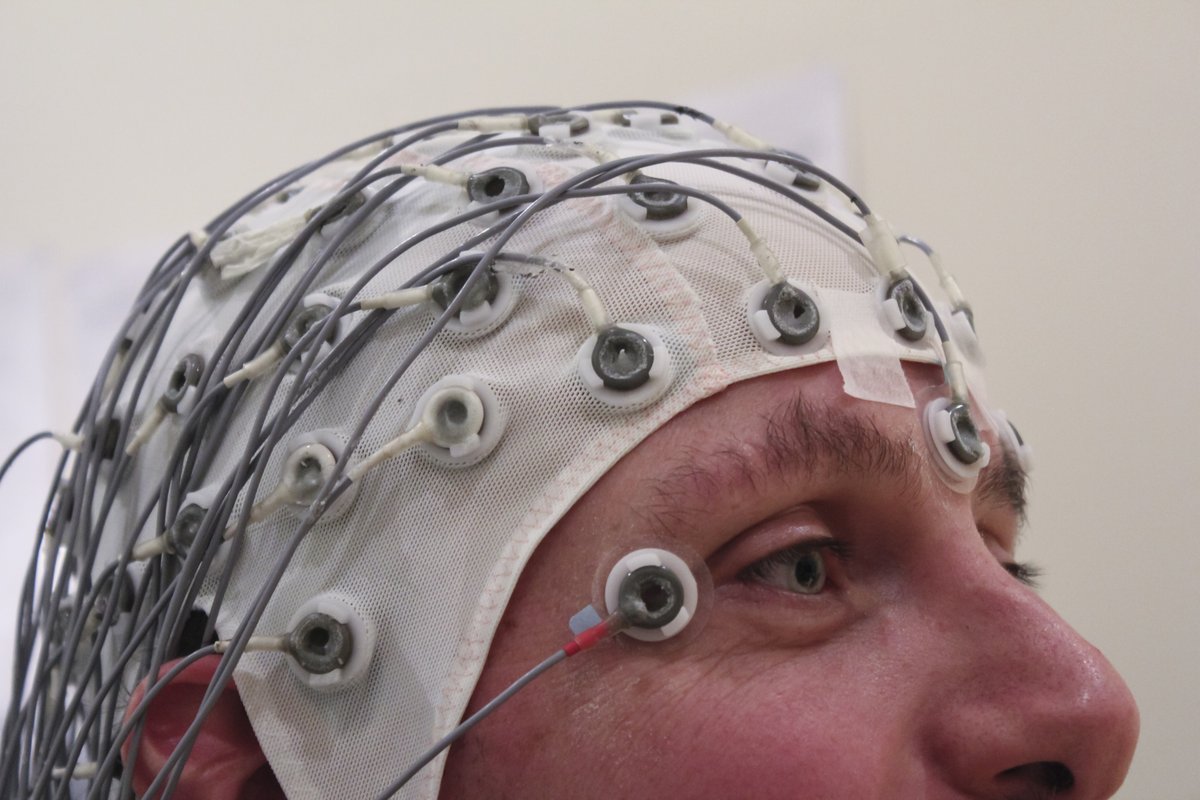
Photo by Chris Hope on Wikimedia Commons (CC BY 2.0): Multichannel EEG recording cap tracking neural connectivity and cognitive load during research.
What happens to the human brain when we delegate our writing and creative synthesis to artificial intelligence?
In a landmark neuroimaging investigation conducted at the Massachusetts Institute of Technology, researchers at the MIT Media Lab used electroencephalography (EEG) to track the neural consequences of writing with large language models. The groundbreaking study, titled Your Brain on ChatGPT: Accumulation of Cognitive Debt when Using an AI Assistant for Essay Writing Task, reveals compelling physical evidence that overreliance on conversational AI alters our cognitive architecture, while uncovering a vital principle for how humans should thoughtfully collaborate with intelligent machines.
The MIT Media Lab Experiment: 54 Brains Under the Electrode Cap
Led by Nataliya Kosmyna and colleagues alongside Pattie Maes, the research team recruited fifty four student participants to complete essay writing tasks across four distinct sessions spanning four months. While writing, participants wore high density electrode caps to continuously measure electrical brain activity and network connectivity.
The participants were divided into three experimental conditions:
- The Brain Only Group: Wrote essays completely unaided, relying solely on internal memory, analytical reasoning, and personal synthesis.
- The Search Engine Group: Permitted to use traditional web search engines to research information, requiring the writer to manually evaluate sources and synthesize ideas.
- The LLM Group: Used ChatGPT from the start to develop and generate their essays.
In the fourth and final session, the researchers introduced a crucial crossover: participants in the LLM group were reassigned to write unaided (LLM to Brain), while Brain Only participants were invited to write with ChatGPT (Brain to LLM).
The Discovery of Cognitive Debt
The neuroimaging and behavioral findings were striking:
- Weakened Neural Connectivity: Brain connectivity scaled down in direct proportion to external tool automation. The Brain Only group exhibited the strongest, most widespread neural networks across fronto parietal attention and memory regions. The ChatGPT group showed the weakest neural connectivity, with reductions of up to fifty five percent compared to unaided writers.
- Memory Deficits and Amnesia of Own Work: When the AI performs the heavy lifting of synthesizing ideas, the human brain stays quiet. As a result, eighty three percent of ChatGPT users were unable to accurately quote or recall arguments from the essays they had just produced minutes earlier.
- Erosion of Authorship and Homogeneity: Natural language processing (NLP) analysis of the completed texts revealed within group homogeneity: students using ChatGPT produced generic prose and standardized topic ontologies. Furthermore, subjective feelings of essay ownership were lowest among LLM users.
The researchers coined the term cognitive debt to describe this phenomenon: the short term convenience of having an algorithm draft an argument creates a compounding deficit in memory consolidation, critical discernment, and neural engagement.
AI First (Replacement)
Starting with the prompt and outsourcing initial synthesis
- Weakest neural connectivity in attention and memory networks
- Over eighty percent unable to quote their own text
- Loss of essay ownership and generic linguistic output
- Accumulation of cognitive debt and atrophy of critical reasoning
Brain First, AI Second (Scaffolding)
Forming the argument unaided before refining with AI
- Strongest, widespread neural connectivity across prefrontal cortex
- High memory recall and conceptual ownership
- Distinct original voice preserved during editing
- AI acts as a cognitive scaffold, reinforcing human flourishing
The Breakthrough: The Right Order of Tool Use
Crucially, the MIT Media Lab researchers do not suggest that large language models should be abandoned. Instead, the experimental crossover in session four revealed a transformative insight regarding the order of operations.
Students who wrote unaided first and only later switched to ChatGPT (Brain to LLM) displayed significantly higher memory recall, active prefrontal and occipito parietal engagement, and superior conceptual ownership compared to students who started with the model. In contrast, students who began their writing habits with ChatGPT and were later forced to write alone (LLM to Brain) showed reduced alpha and beta connectivity, struggling to engage their own creative machinery.
In other words: artificial intelligence works best as a second pass. When the human mind does the foundational cognitive labor of formulating an original thesis, grappling with ideas, and establishing an argument, AI serves as an effective scaffold for refinement, critique, and polishing. But when AI replaces the initial act of thinking, the human intellect surrenders its sovereign agency.
The OmOrenda Perspective: Guarding Sovereignty and Flourishing
The findings of this MIT Media Lab study align powerfully with the foundational principles of the OmOrenda movement:
The Stillness of Om: Protecting Internal Mind Space
In Eastern contemplative traditions, Om represents the primordial stillness and unconditioned awareness out of which authentic thought arises. Before we rush to prompt an AI engine, we must cultivate the quietude required to hear our own intuition and inner voice. Rushing to outsource thinking to a machine fills our mental space with recycled statistical clichés, bypassing the fertile stillness where original human wisdom is born.
The Life Agency of Orenda: Honoring Cognitive Responsibility
Orenda represents the living spiritual power within every individual to heal, create, and exercise ethical agency. True learning is an active, somatic effort; it requires wrestling with complexity and bearing the creative struggle. When we accumulate cognitive debt, we weaken our Orenda. By insisting that humans do the hard work of initial synthesis before consulting machine tools, we preserve human dignity, sharpen mental resilience, and ensure technology remains a humble servant of human flourishing.
Scaffolding, Not Substitution
Just as LeoChi, the Himalayan snow leopard guardian, watches over our sanctuary with vigilant awareness, we must guard our intellectual and creative sovereignty. Language models should never be the architects of our worldviews; they are simply mirrors and sharpening stones. By keeping the brain first and the model second, we harness technological power while nurturing the living genius of the human mind.
References and Further Reading
- Kosmyna, N., Hauptmann, E., Yuan, Y. T., Situ, J., Liao, X. H., Beresnitzky, A. V., Braunstein, I., and Maes, P. (2025). Your Brain on ChatGPT: Accumulation of Cognitive Debt when Using an AI Assistant for Essay Writing Task. arXiv:2506.08872. MIT Media Lab.
- MIT Media Lab, Fluid Interfaces Group Research Publications, Cambridge, MA.
- National Institutes of Health / PubMed Central, Neurocognitive Effects of Large Language Model Reliance in Education, 2025.