
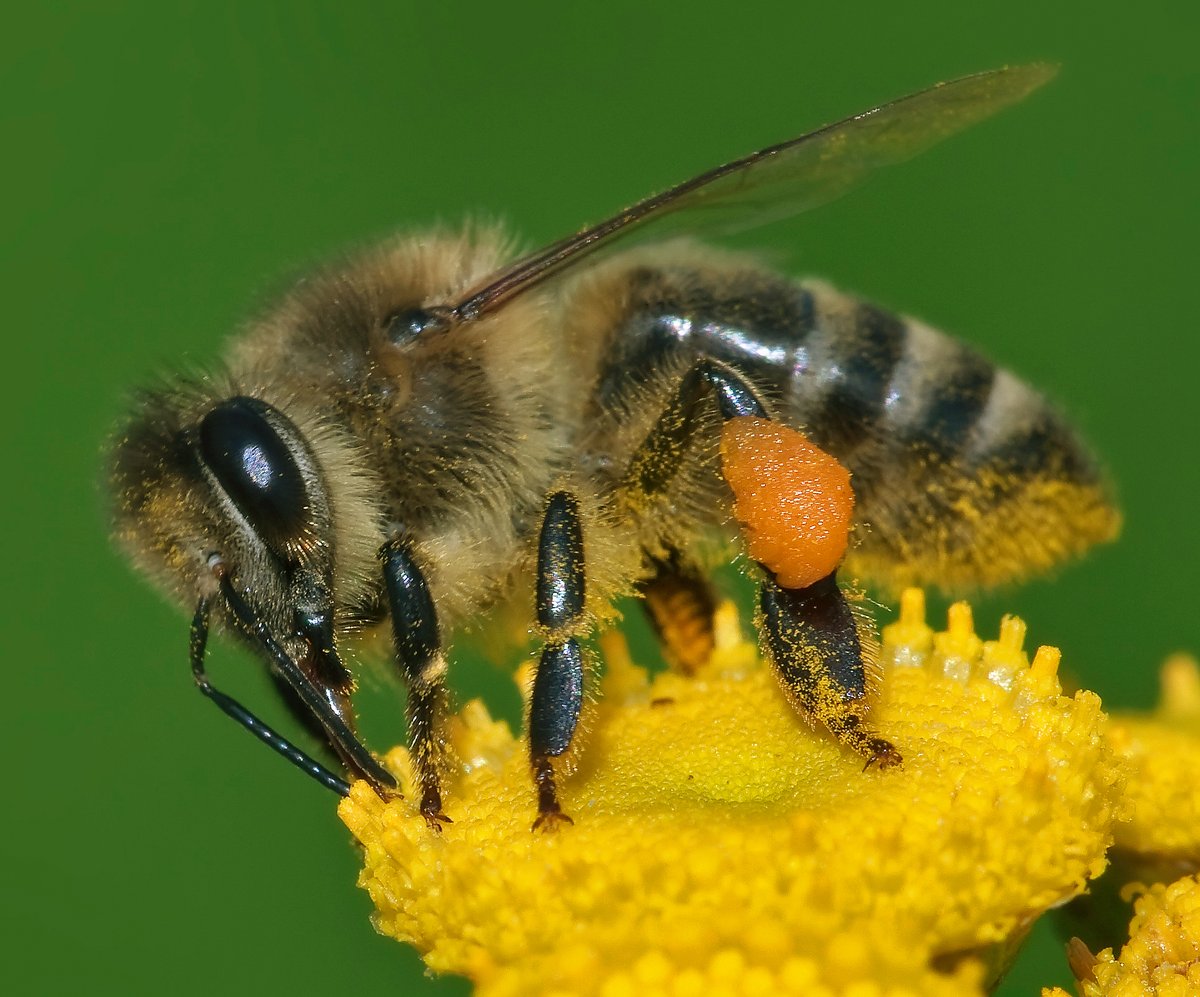
Photo by Andreas Trepte on Wikimedia Commons (CC BY SA 2.5)
For centuries, Western philosophical thought treated insects and small creatures as biological automatons. Under the Cartesian worldview, animals without human speech were viewed as clockwork mechanisms driven strictly by hardwired reflexes, devoid of internal feeling, joy, or suffering. If an ant navigated a maze or a bee located nectar, it was dismissed as pure algorithmic instinct.
That paradigm is experiencing an extraordinary collapse. As science writer Rowan Hooper explores in an illuminating feature for New Scientist, mounting experimental discoveries across behavioral ecology, evolutionary neuroscience, and cognitive biology demonstrate that our fellow creatures possess rich, subjective emotional worlds. From bumblebees that roll wooden balls for the pure fun of play, to fruit flies that seek comfort when rejected, the boundaries of sentience are expanding far beyond the human sphere.
The Playful Bee and the Chemistry of Longing
One of the most persistent scientific dogmas was the belief that play was an exclusive luxury of large brained mammals like dolphins, dogs, and chimpanzees. Play requires spare metabolic energy, curiosity, and intrinsic motivation. It serves no immediate survival goal such as feeding or evading a predator.
At Queen Mary University of London, behavioral ecologist Lars Chittka and his team created a miniature ball pit adjacent to a bumblebee hive. The researchers watched in amazement as individual bees voluntarily approached small wooden balls and spent extended periods rolling them around. The bees received no sugar reward, no food reinforcement, and no training. Even more compelling, individual bees actively returned to the play arena across multiple days, choosing the playful experience for its own sake.
Similar behaviors have emerged in fruit flies, who readily seek out spinning carousels in laboratory environments, riding the motion repeatedly. Play suggests an internal affective state where the activity itself produces pleasant subjective sensations.
Even more startling is how insects respond to emotional distress. In controlled studies on Drosophila, male fruit flies subjected to repeated sexual rejection by females consistently chose food infused with fifteen percent ethanol over normal food. Sexually satisfied males, by contrast, showed no preference for alcohol. Neuroscientists identified the underlying molecular pathway linking social rejection to chemical reward, demonstrating that the fly experiences an aversive emotional state that it actively seeks to alleviate.
Cautious Bees and Ghostly Predators
Feelings in the animal kingdom are not limited to pleasure; they also encompass vigilance, caution, and mood. Lars Chittka discovered that when bumblebees encounter predatory crab spiders lurking inside flowers, their entire disposition shifts. Following a close encounter with a predator, bees fly noticeably slower, approach blossoms with hesitation, and carefully scan petals before landing.
Remarkably, this cautious demeanor persists long after the danger has passed. Bees frequently inspect harmless blossoms with no spiders present, hover anxiously, and then abandon the flower entirely. As Chittka notes, the bees behave as if they have seen a ghost. In human psychology, we recognize this phenomenon as post traumatic vigilance: an enduring emotional state that colors future perception and creates false alarms.
When an insect exhibits lasting changes in risk assessment after a traumatic event, it is operating on an internal emotional state rather than an immediate mechanical stimulus.
Planning, Future Thought, and the Mirror Test
Beyond insects, cognitive research is revealing unexpected depth across diverse animal lineages:
- Delay of Gratification in Cuttlefish: Psychologist Nicola Clayton at the University of Cambridge adapted the famous Stanford marshmallow test for marine cephalopods. Cuttlefish proved capable of turning down an immediate treat (a live shrimp) when they learned that waiting would yield two treats later. Resisting impulse in favor of a delayed reward requires mental self control and the ability to anticipate the future.
- Episodic Memory in Jays: Eurasian jays demonstrate long term, event based memory. They recall not only where they cached seeds, but who was watching them at the time, modifying their future retrieval strategies to prevent theft.
- Self Perception in Cleaner Wrasse: The tiny reef fish known as the cleaner wrasse recently passed the classic mirror self recognition test. Researchers observed a cleaner fish pick up a piece of shrimp, drop it in front of a mirror, and watch the reflection fall, acting like an intuitive physicist testing the reflective properties of glass.
The Three Dawns of Consciousness
Philosophers often describe the origin of subjective experience as the hard problem of consciousness: explaining why any physical process should feel like anything from the inside. To move beyond endless theoretical gridlock, philosopher Jonathan Birch at the London School of Economics, together with neurobiologist Simona Ginsburg and geneticist Eva Jablonka, developed a practical framework called Unlimited Associative Learning (UAL).
Instead of demanding human speech or abstract symbolic logic, UAL evaluates consciousness through an organism’s capacity to synthesize multiple novel sensory cues and adjust behavior based on experience. Animals that display UAL do not simply calculate; they form internal evaluations of what is beneficial or harmful to their own bodies.
Their research reveals a breathtaking evolutionary conclusion: consciousness did not emerge a single time at the pinnacle of a linear mammalian hierarchy. Instead, it evolved independently along at least three distinct branches of life:
- Vertebrates: Developing through fish, reptiles, birds, and mammals.
- Cephalopods: Giving rise to the alien intelligence and rich sentience of octopuses and cuttlefish.
- Arthropods: Producing the intricate, emotionally responsive inner worlds of insects, spiders, and crustaceans.
As philosopher Tim Bayne notes, the fundamental biological purpose of consciousness is homeostatic regulation. Sentience alerts an organism to critical survival priorities: hunger, temperature, bodily harm, comfort, and reproduction. This explains why bodily sensations such as thirst or pain are so vivid and undeniable. Consciousness is life keeping track of its own existence.
Ethical Stewardship and the Sacred Web of Life
These scientific revelations carry profound ethical consequences. For decades, industrial practices have treated billions of invertebrates as disposable commodities, assuming that small brains imply a complete absence of suffering. Yet if bees feel fear, if flies experience frustration, and if octopuses possess vivid mental lives, our moral responsibility expands dramatically.
This scientific shift resonates deeply with timeless contemplative traditions. In Eastern philosophy (the peaceful root of Om), all sentient beings are recognized as ripples of a shared, continuous awareness. In Indigenous Haudenosaunee wisdom (the life giving force of Orenda), stewardship is grounded in reciprocal kinship with the more than human world. Every living creature, from the towering snow leopard guardian to the solitary honeybee pollinating a wildflower, possesses intrinsic agency and dignity.
As we step into our gardens and sanctuaries, let us look upon the humble bee with fresh eyes: not as a mindless pollen collector, but as a conscious, feeling traveler sharing our fragile planetary home.
References and Sources
- Rowan Hooper, The understanding that even bees have feelings is changing our view of consciousness, New Scientist, October 27, 2026.
- Lars Chittka, The Mind of a Bee, Princeton University Press.
- Jonathan Birch, Simona Ginsburg, and Eva Jablonka, Unlimited Associative Learning and the Evolution of Consciousness.
- Nicola Clayton, Comparative Cognition and Episodic Memory in Corvids and Cephalopods, University of Cambridge.