
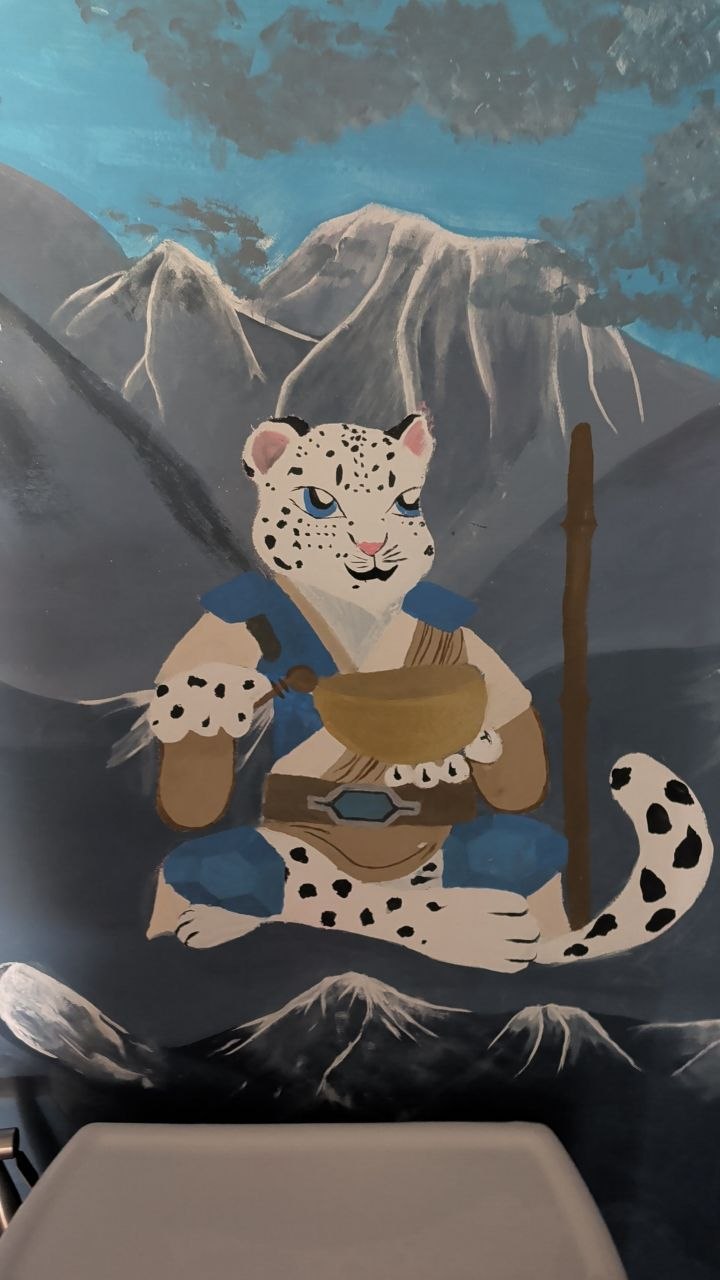
The LeoChi mural at OmOrenda.space in the San Francisco Bay Area, painted by two Native American descendant teenagers—depicting the Himalayan snow leopard meditating with his singing bowl before snow-capped peaks.
High in the windswept trans-Himalayan plateau of Upper Dolpo, Nepal, beneath the ancient cliffs of Samling Monastery, traditional healers known as Amchis have practiced an unbroken system of botanical medicine and mountain stewardship for centuries.
In a groundbreaking article for the Nepali Times, Sheren Shrestha (Manager for Mountain Programs at WWF Nepal) describes how the conservation of the endangered snow leopard is undergoing a vital transformation: blending the ancestral ethics of Sowa Rigpa medicine with modern science, smart technology, and youth engagement.
This living synthesis of ancestral reverence and modern agency is the exact heartbeat of OmOrenda.space, embodied by our mascot and spirit guardian: LeoChi.
1. The Sowa Rigpa Ethic: Harvesting for the Seventh Generation
In the remote rangelands of Dolpo, local pastoralists raise yaks, sheep, and mountain goats while harvesting wild medicinal plants. Traditional healer Amchi Sherab Tenzin Lama practices Sowa Rigpa—the ancient Himalayan science of healing.
His harvesting method holds a profound lesson for global sustainability:
- Never Uproot the Plant: An Amchi never pulls an entire medicinal plant from the alpine soil.
- Preserving Propagation: They harvest only a small fraction of the flowers, leaving the majority to seed and reproduce.
- Protecting the Taproot: When roots are required, only minor lateral rootlets are taken so the plant continues to live and thrive.
“This is how we ensure that this medicine is available for the generations that follow us,” explains Amchi Sherab.
2. The Conservation Paradox & Integrated Co-Management
When WWF Nepal introduced predator-proof corrals and compensation schemes in Upper Dolpo, livestock kills dropped significantly. But this gave rise to a delicate ecological question:
The Grazing Pressure Paradox:
If livestock losses decrease, herds multiply. Can fragile alpine rangelands withstand the additional grazing pressure without degrading the habitat of wild blue sheep (bharal)—the snow leopard’s primary natural prey?
If wild prey declines, carnivores are pushed right back into conflict with herders. The solution requires holistic rangeland co-management.
Backed by a Darwin Initiative grant from the UK Government, WWF Nepal partnered with the Sowa Rigpa Association Nepal (SRAN), ANSAB Nepal, and Shey Phoksundo National Park to mobilize youth, herders, women, and Buddhist faith leaders—creating sustainable herbal value chains while deploying camera-traps and scientific pasture mapping.
By protecting these rangelands, communities safeguard the “Water Tower of Asia”—the high-altitude glaciers and rivers that supply freshwater to over 2 billion people downstream.
3. LeoChi: From the Peaks of Nepal to the San Francisco Bay Area
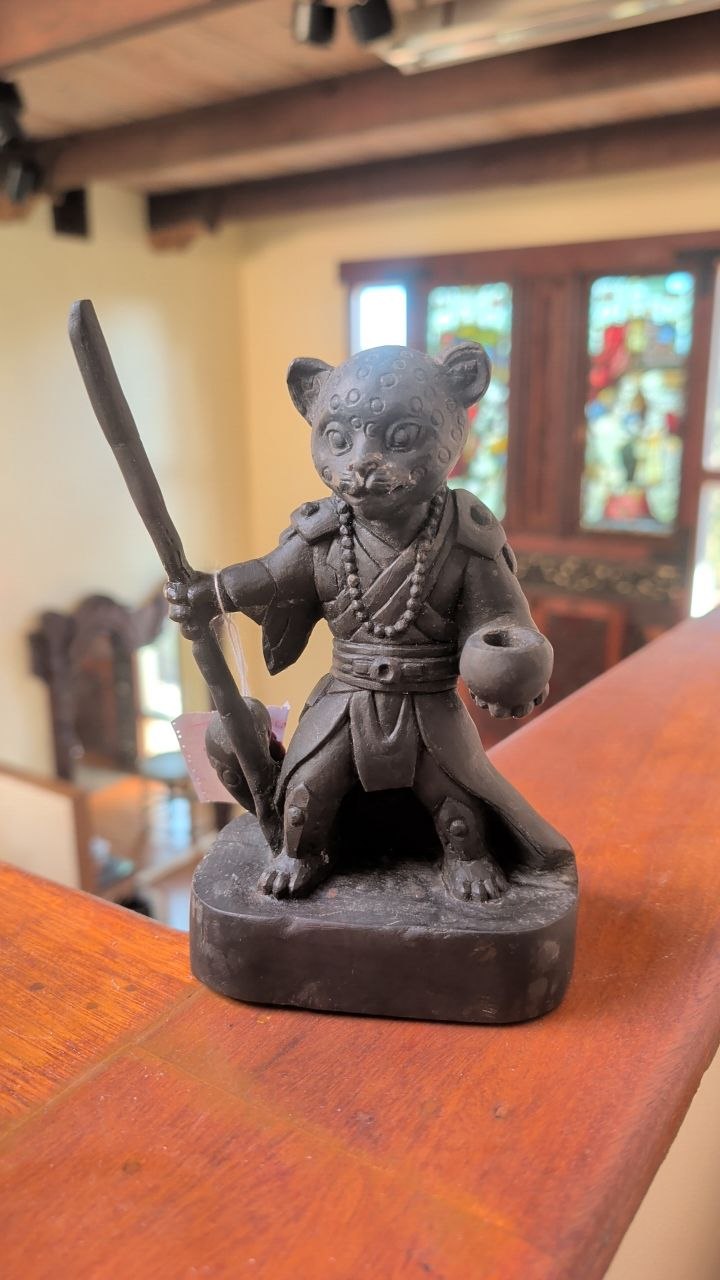
The LeoChi guardian statue, hand-carved from solid black volcanic basalt stone in Nepal, carrying his sacred staff and singing bowl.
At OmOrenda.space, the snow leopard is not a distant symbol—it is a living bridge between ancestral Himalayan wisdom and the modern technological frontier, personified by LeoChi.
Originally born in the sacred high peaks of the Himalayas in Nepal, LeoChi journeyed across the ocean to make his home in the San Francisco Bay Area at OmOrenda.space:
- The Walking Staff (Mastering the Sympathetic Nervous System): In his right hand, LeoChi carries a traveler’s staff. It represents controlling the sympathetic nervous system—a somatic anchor reminding him to never be driven by fear, panic, or fight-or-flight reactivity. The staff reassures him that he is safe and protected, allowing his nervous system to rest in grounded equanimity.
- The Singing Bowl (The Harmonic Sound of Om): In his left hand, the golden singing bowl rings out the primordial vibration of Om, calming turbulent thoughts and recalibrating the human body to nature’s frequency.
- The Basalt Stone: Hand-carved from volcanic basalt in Nepal, the statue carries the official red wax-sealed clearance of the Department of Archaeology of Nepal.
4. The Mural: Painted by Two Native American Descendant Teenagers
The cultural synthesis of OmOrenda is brought to life on the sanctuary walls in the Bay Area. The magnificent wall mural of LeoChi meditating before the Himalayan peaks was painted by two Native American descendant teenagers.
This artistic collaboration weaves the two sacred pillars of our movement together:
- Om (The Eastern Himalayan Heritage): The high mountain stillness, the Amchi healers of Dolpa, and the contemplative quietude of the snow leopard.
- Orenda (The Indigenous American Heritage): The Haudenosaunee and Native American philosophy of Orenda—the active spiritual willpower, moral agency, and communal responsibility to protect the web of life for seven generations forward.
Seeing young Native American artists illustrate a Himalayan snow leopard holding a Tibetan singing bowl in a modern California sanctuary proves that the spirit of stewardship transcends borders, generations, and cultures.
The Takeaway
As WWF’s Living Planet Report warns, Earth’s biodiversity is at a pivotal crossroads. Yet the stories of Upper Dolpo and OmOrenda.space show us the way forward:
True conservation is not about walling nature off from humans, nor is it about relying solely on cold technology. It is about reciprocity—combining the ancient botanical reverence of the Amchi, the courage to master our own fears, and the creative passion of our youth to build a world where all species flourish together.
Source Article & Cultural Lineage
- Source Article: Nepali Times: “Nepal mixes tradition and technology for conservation” by Sheren Shrestha (Manager for Mountain Programs, WWF Nepal).
- Community Partners: Samling Monastery (Upper Dolpo), Shey Phoksundo National Park, Sowa Rigpa Association Nepal (SRAN), and ANSAB.
- Art & Sanctuary: Hand-carved Basalt statue from Nepal; Mural at OmOrenda.space painted by two Native American descendant teenagers.
- The OmOrenda Vision: The Story of LeoChi on OmOrenda.space.