

The Sweet Spot: How Much Sleep You Really Need for Healthy Aging
Key Takeaways: 5 Salient Features
- The 7-Hour Sweet Spot: Groundbreaking research reveals that 7 hours is the optimal sleep duration for preserving cognitive health in middle-to-older age adults.
- The U-Shaped Curve: Sleeping significantly more or less than 7 hours is directly linked to accelerated biological aging, poorer mental health, and cognitive decline.
- Dangers of Short Sleep: Chronically getting under 6 hours of rest prevents your brain from clearing Alzheimer’s-related neurotoxins and spikes inflammation-driving cortisol.
- Consistency is Crucial: Sleep regularity—waking up at the exact same time every day—stabilizes your master clock and is just as important as the total hours you sleep.
- Environment Matters: A cool room (around 65°F) combined with a strict “digital sunset” 90 minutes before bed are non-negotiable for deep, restorative cellular repair.
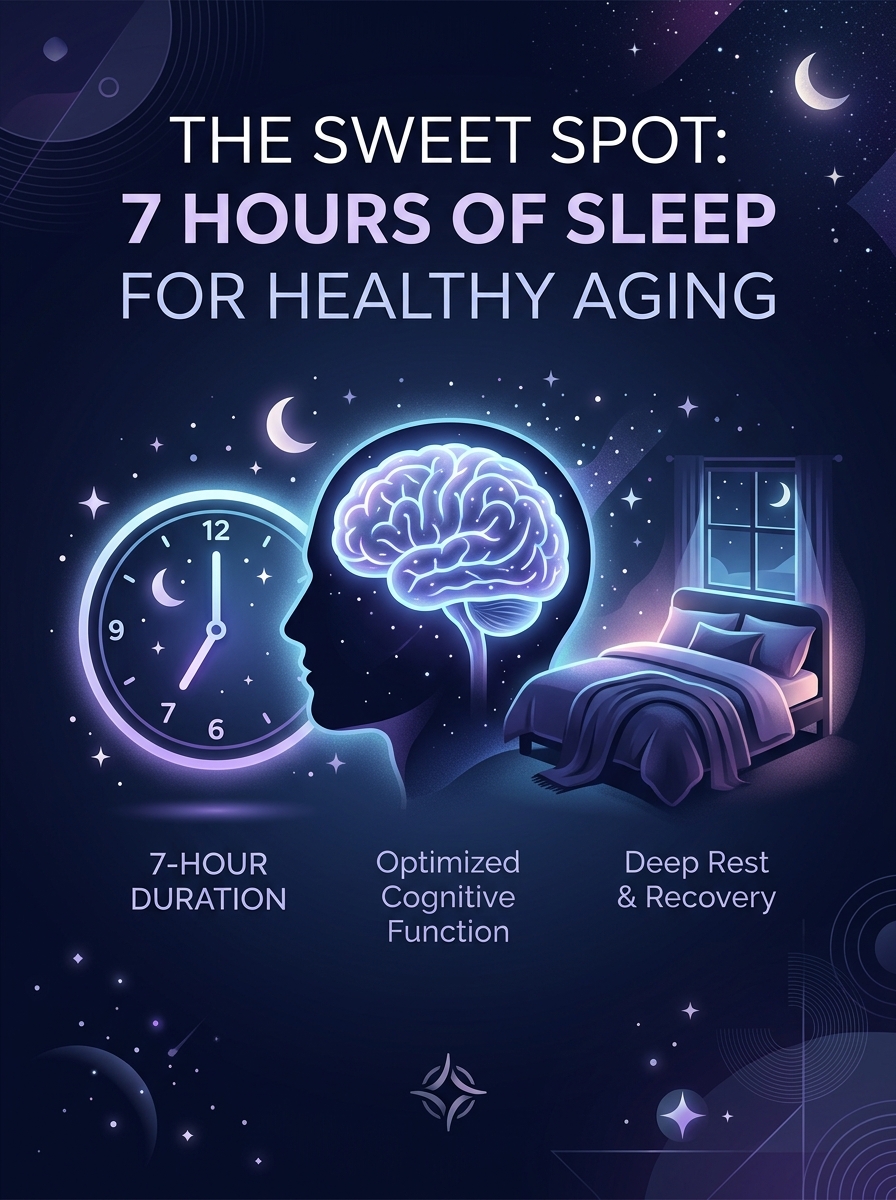
We’ve all heard the traditional advice: “Get your eight hours of sleep.” But as we age, does that blanket recommendation still hold true? According to recent scientific studies exploring the intersection of longevity and rest, the answer is a resounding no. There is a precise “sweet spot” when it comes to sleep duration and healthy aging.
The Magic Number: 7 Hours
Recent large-scale studies have pinpointed exactly how much sleep provides the optimal benefits for cognitive health, mental well-being, and physical longevity. The magic number? Seven hours.
Researchers have discovered a U-shaped relationship between sleep duration and cognitive decline. This means that straying too far from the seven-hour mark in either direction—sleeping significantly less or significantly more—is associated with an increased risk of cognitive impairment, poorer mental health, and accelerated biological aging.
Why Too Little (or Too Much) is Harmful
- Short Sleep (Under 6 Hours): Chronic sleep deprivation prevents the brain from entering the deep sleep cycles required to clear out neurotoxins (like the amyloid-beta proteins associated with Alzheimer’s). It also triggers prolonged spikes in cortisol, driving systemic inflammation.
- Long Sleep (Over 8 Hours): Surprisingly, consistently sleeping more than eight hours is also flagged as a risk factor. While it may sometimes be a symptom of underlying health issues rather than the cause, excessive sleep can disrupt the natural circadian rhythm and lead to grogginess and fragmented sleep cycles.
Consistency Trumps Quantity
While hitting that seven-hour mark is crucial, experts emphasize that sleep regularity is just as important as sleep duration. Going to bed and waking up at the exact same time every day stabilizes the Suprachiasmatic Nucleus (your brain’s master clock), allowing your body to release melatonin and cortisol perfectly in sync with your day.
Tips to Hit the Sweet Spot
If you’re looking to optimize your sleep for longevity, start with these actionable habits:
- Lock in your wake time: Your morning wake-up time is the anchor for your entire circadian rhythm. Keep it consistent, even on weekends.
- Embrace the “Digital Sunset”: Turn off screens 90 minutes before bed to protect your brain from blue light, which tricks your body into thinking it’s still daytime.
- Keep it cool and dark: A bedroom temperature of around 65°F (18°C) physically signals to your body that it is time to hibernate and repair.
Aging healthily isn’t just about what you eat or how you move—it’s about how well you recover. By aiming for seven consistent hours of quality rest, you are giving your brain the exact amount of time it needs to future-proof itself.
Inspired by recent coverage in The Washington Post.