
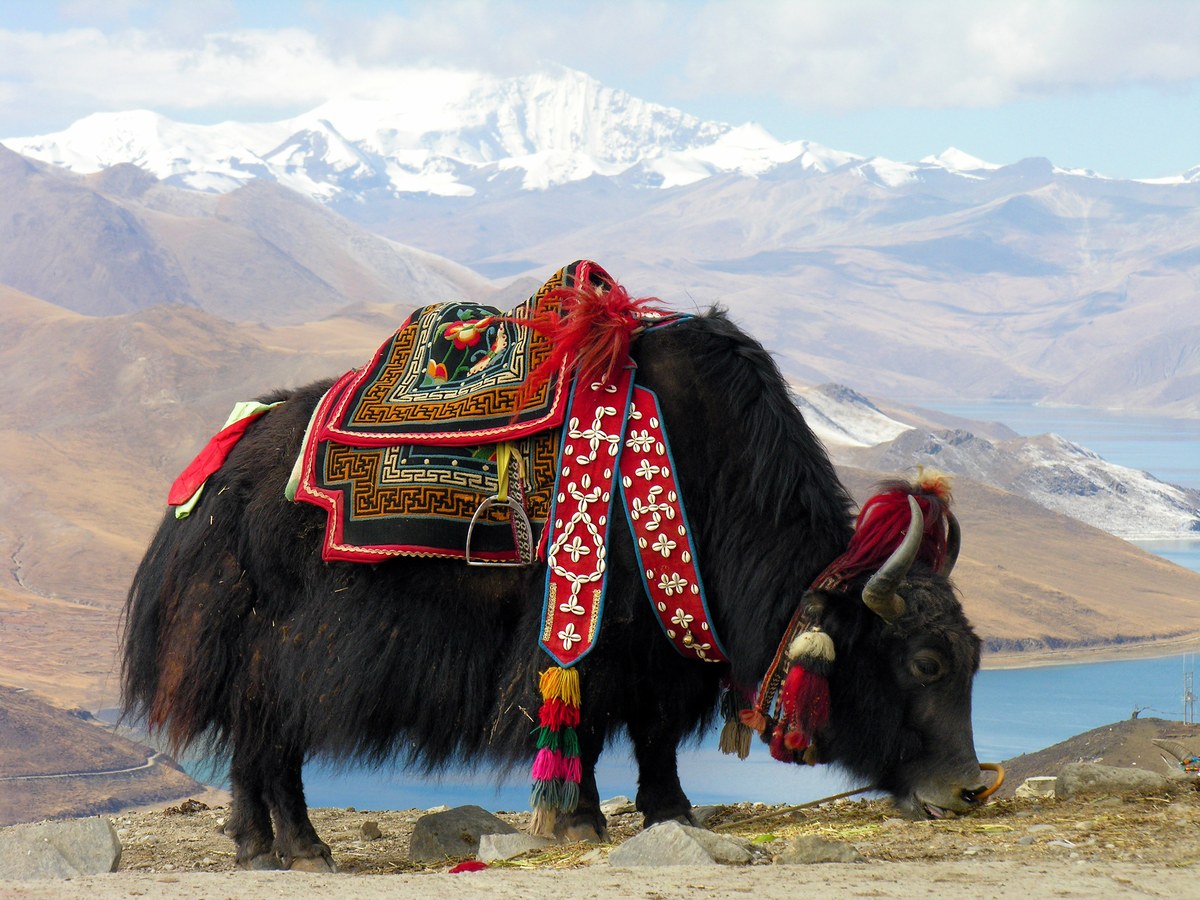
Photograph by Dennis G Jarvis (CC BY SA 3.0): The gentle domestic yak grazing near high alpine lakes, the sacred companion whose milk sustained generations of Himalayan highlanders through fierce winters.
High above the cloudline, where the air grows thin and the silence rings like a silver bell, LeoChi sat on a sun warmed granite ledge. His thick, rosette dappled coat kept him warm against the whistling wind of the high passes. LeoChi, the snow leopard spirit guardian of OmOrenda, was born amidst the sacred crags of Nepal, where glaciers carve paths through the roof of the world.
Today, LeoChi lives at OmOrenda in the San Francisco Bay Area, resting beneath the tall coastal redwoods. Yet his heart always remains anchored to the frozen heights of his Himalayan birthplace. Looking across the Pacific toward his ancestral home, LeoChi smiled gently as he caught word of a remarkable scientific discovery just published in the journal Scientific Reports.
For centuries, travelers and mountaineers wondered how human beings could thrive in places where freezing blizzards howl and crops cannot grow. The secret, as LeoChi had witnessed from his mountain perches for millennia, was written into the deep bond between high altitude herders and their animals: a sacred kinship that literally rewrote the human genome.
The Mystery of the Winter Milk
LeoChi remembered watching the Changpa, Sherpa, Bhutia, and Tamang pastoralists when winter cloaked the valleys in deep snow. In those desolate months, green barley fields vanished beneath the frost. No vegetables grew. Yet inside the stone huts and yak hair tents, laughter echoed around roaring wood stoves as families shared bowls of steaming tea churned with salt and golden yak butter.
For most adult mammals across planet Earth: and indeed for most adult humans: milk is something meant only for infancy. Once a mammal grows past weaning, the body naturally silences the gene that produces lactase, the digestive enzyme needed to break down lactose sugars. Drinking milk as an adult usually causes severe stomach distress.
How did these mountain communities drink rich yak and cow milk day after day, turning animal dairy into life saving warmth, cellular repair, and muscular strength? Geneticists had long believed that the genetic mutation allowing adults to digest milk: known as lactase persistence: entered South Asia solely through migrating cattle herders from the western Eurasian steppes. But the Himalayan highlands had a much deeper, richer story to tell.
The Northern Highland Heritage
The distinct high altitude variant shared between Tibetans, Sherpas, and Bhutias, born from surviving long frozen winters on yak butter and warm tea.
The Southern Valley Stream
The widespread South Asian and Eurasian pastoral variant flowing northward along trans Himalayan trade trails with zebu cattle and buffalo.
The Genetic Crossroad
Nineteen Himalayan communities meeting in genetic convergence, carrying both ancestral signatures within their living genome.
The Living Wisdom (OmOrenda)
Active human resilience and deep biological partnership with animals, bridging ancient mountain endurance with modern regenerative science.
The Genetic Crossroads: A Groundbreaking Study in Nature
A team of genetic researchers from Banaras Hindu University, University of North Bengal, and international institutes set out to solve the Himalayan mystery. They conducted a meticulous genetic screening of nineteen distinct Himalayan and adjoining populations across India, Nepal, and the borders of Tibet.
What they uncovered within the regulatory DNA of the lactase gene was extraordinary:
- The Discovery of Four Distinct Variants: For the first time in Indian scientific literature, researchers identified four separate genetic variants that switch on adult milk digestion.
- The Ancient Tibetan Heritage (13838G to A): The primary variant carried by high altitude Tibetans was discovered alive and thriving across Bhutias, Sherpas, Tamangs, Nyishi, and Khasi communities. This genetic signature arose independently on the Tibetan Plateau, an evolutionary gift born of the high passes.
- The Southern Plains Connection (13910C to T): Alongside the Tibetan variant, many Himalayan communities also carried the classic South Asian and European variant, introduced through ancient trade trails and cattle herding with zebu cattle and river buffalo.
- The Rare Micro Mutations: In populations from the Darjeeling hills and Nagaland, scientists observed two exceptionally rare variants (13906T to A and 13908C to T), proving that the Himalayan slopes served as a dynamic crucible of independent evolutionary adaptation.
The study proves that Himalayan communities are not genetically isolated outposts. Instead, they stand as the living biological crossroads between the Tibetan plateau and the South Asian subcontinent, carrying the genetic heritage of both worlds in their veins.
The Teachings of LeoChi: The Stillness of Om and the Agency of Orenda
As the fog rolled through the California redwoods at OmOrenda house, LeoChi rested his paws on a smooth basalt stone and reflected on what this scientific paper means for humanity today:
1. The Stillness of Om (Listening to Living Ecology)
In the high Himalayas, survival was never about conquering nature with brute force. It was about listening to the quiet rhythm of the mountains: the contemplative stillness of Om. Pastoralists lived in tune with seasonal migrations, moving their herds to high summer meadows and descending to sheltered valleys before the first autumn snows. Their biology adapted naturally because their lives were harmonious with the land and its creatures.
2. The Active Kinship of Orenda (Sacred Reciprocity)
In the philosophy of OmOrenda, Orenda is the active life energy and ethical agency that unites all living beings. The relationship between a Himalayan herder and a yak was never an extractive business transaction. The family cared for the herd through blizzards, provided shelter, and honored their animals with garlands and blessings: just as we celebrate during Kukur Tihar. In return, the herd offered the milk that sustained human life.
Over thousands of years, this mutual devotion became inscribed into human DNA. It is a breathtaking biological proof of what Clan Mothers and ancient sages always taught: when humans treat their animal companions with reverent care, the entire circle of life flourishes.
Bridging the Himalayas to Silicon Valley
From his sanctuary at OmOrenda in the Bay Area, LeoChi watches over a world rapidly adopting artificial intelligence, space habitats, and modern biotechnology. Yet as humanity builds algorithms and reaches for the stars, LeoChi whispers a timeless reminder from the high snowy peaks:
True resilience does not come from isolating ourselves in sterile, mechanical bubbles. It comes from honoring the ancestral wisdom of our bodies, respecting the living creatures who share our journey, and anchoring our rapid technological progress in ethical kinship, compassion, and deep planetary peace.
References and Scientific Source
- Saptaparni De, Diksha Rai, Kumarasamy Thangaraj, and Gyaneshwer Chaubey et al., Populations from Indian Himalayan and adjoining regions share their associated lactase persistence variants with the Tibetans and South Asians, Scientific Reports, Volume 16, Article Number 37561, November 2026.
- Ministry of Fisheries, Animal Husbandry and Dairying, Government of India, Basic Animal Husbandry Statistics on Milk Production and Pastoralism.
- Gallego Romero et al., Herders of Indian and European cattle share their predominant allele for lactase persistence, Molecular Biology and Evolution.
- Peng et al., Lactase persistence independent origins in Tibetan populations from the Tibetan Plateau, Journal of Human Genetics.