

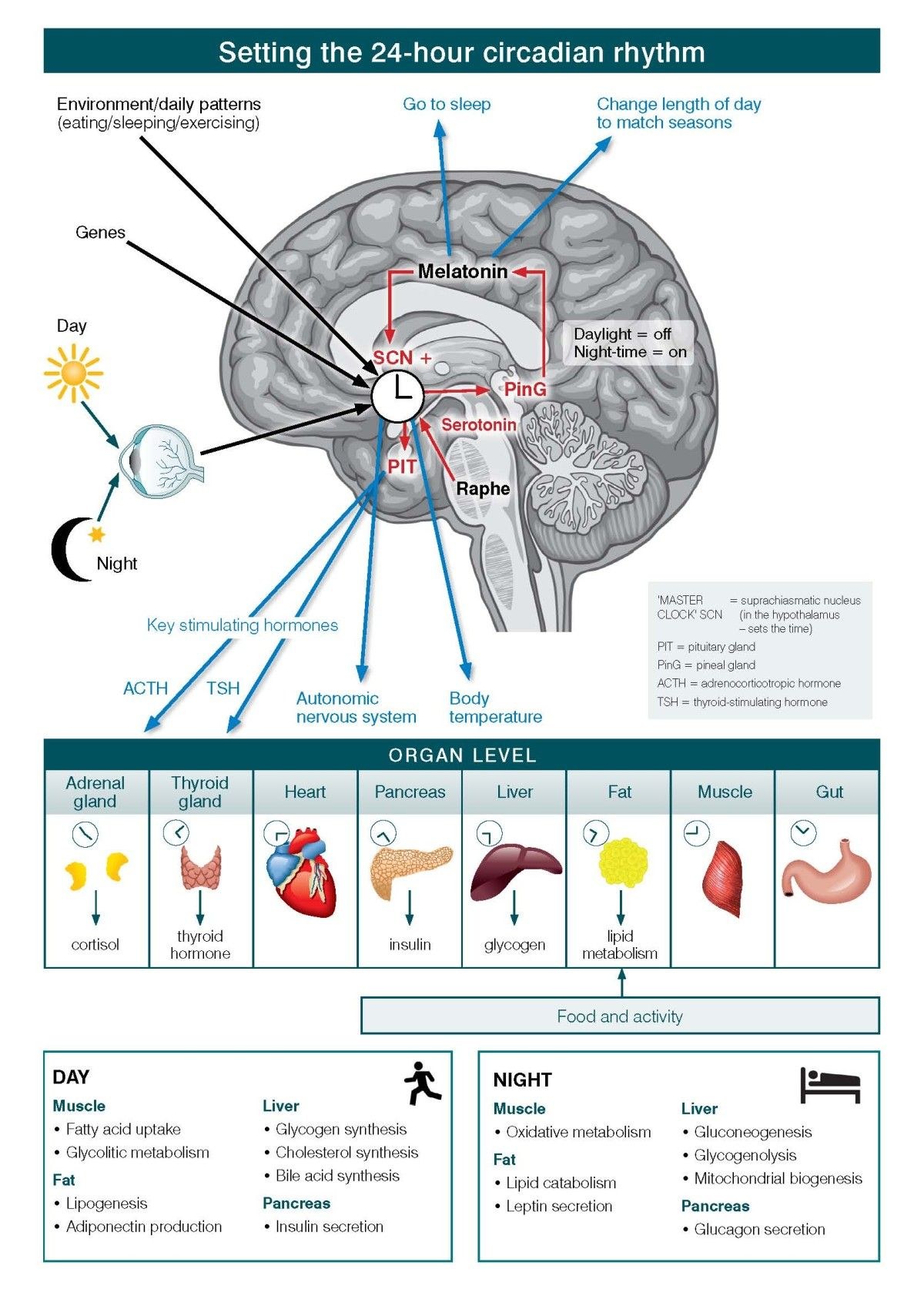
Scientific diagram by Ian B Hickie et al. (CC BY 3.0): The master circadian clock in the human brain, showing how light and regular daily timing synchronize hormonal, metabolic, and emotional regulation.
For decades, conventional sleep advice has fixated almost exclusively on a single question: How many hours did you sleep last night? Public health campaigns urged people to achieve the gold standard of seven to eight hours, assuming that total sleep duration was the primary determinant of restorative rest.
However, groundbreaking research published in the prestigious journal Scientific Reports reveals that duration is only half the story. The consistency of your sleep and wake schedule: known scientifically as sleep regularity: may exert an even stronger influence over emotional stability and mental health.
In a massive longitudinal study led by researchers from the University of California San Francisco (UCSF) and the University of California San Diego (UCSD), scientists analyzed continuous wearable sensor data from nearly 23,000 individuals over months of real world living. Their discovery is striking: people with erratic sleep schedules suffer significantly higher rates of depression, generalized anxiety, and social loneliness, independent of how many total hours they spent in bed.
Remarkably, as little as a thirty minute daily swing in sleep or wake timing can measurably disrupt emotional well being. When examined through the salutogenic philosophy of OmOrenda, this study confirms an ancient truth: human flourishing requires aligning our internal biology with the rhythmic pulses of the natural world.
Inside the Breakthrough: The Sleep Regularity Index (SRI)
To quantify sleep consistency with mathematical precision, researchers utilized the Sleep Regularity Index (SRI). Rather than relying on inaccurate self reported sleep diaries, the team derived SRI scores from continuous biometric data gathered via smart wearable rings in the large scale TemPredict cohort.
The SRI measures the mathematical probability that an individual is in the exact same state: asleep or awake: at any two moments twenty four hours apart:
- A Score of 100: Represents perfect circadian regularity, falling asleep and waking up at the exact same minute every single day.
- A Score of 84: Reflects high regularity, with sleep timing varying by less than an hour from day to day.
- A Score of 75 or Below: Indicates severe circadian irregularity, where sleep and wake windows swing unpredictably by ninety minutes or more across the week.
1. Erratic Sleep Timing
Bedtimes shifting by thirty to sixty minutes confuse the brain master clock in the suprachiasmatic nucleus.
2. Environmental Mismatch
Irregular light exposure, erratic meal schedules, and disrupted social rhythms misalign peripheral clocks in every organ.
3. Autonomic Stress
Chronically elevated sympathetic tone, blunted vagal recovery, and nighttime cortisol surges disrupt emotional regulation.
4. Mental Health Toll
Significant elevation in depressive symptoms, generalized anxiety, and social loneliness across thousands of tracked individuals.
When the researchers correlated SRI scores with monthly standardized clinical assessments for mental health, the results were unmistakable:
- Depression Severity: Participants reporting severe depressive symptoms averaged an SRI score of 74.93, compared to 83.74 among those with healthy, normal moods. Every 5 point drop in sleep regularity was associated with significantly higher odds of worsening depression.
- Anxiety Symptoms: Those with severe generalized anxiety averaged an SRI score of 78.94, compared to 83.67 for individuals with normal anxiety levels.
- Social Loneliness: For the first time in circadian literature, researchers established a direct link between sleep regularity and loneliness. Participants experiencing elevated loneliness averaged an SRI of 81.79, reflecting how circadian misalignment unravels social connectivity and emotional resilience.
The Biology of Circadian Misalignment: Why Erratic Timing Destabilizes Mood
Why does an irregular sleep schedule inflict such heavy damage on psychological health?
Senior study author Dr. Ashley Mason, director of the Sleep, Eating, and Affect Laboratory at UCSF, pointed to circadian rhythm desynchronization. Inside the human hypothalamus sits the suprachiasmatic nucleus (SCN), the body’s master biological clock. The SCN coordinates countless peripheral clocks operating inside liver cells, the cardiovascular system, immune cells, and the gut microbiome.
When you shift your bedtime by an hour or two on weekends or irregular workdays, you create social jet lag. This erratic timing triggers a cascade of biological disturbances:
- Misaligned Solar Cues: Waking up at irregular hours deprives the brain of morning photon exposure, blunting the natural cortisol awakening response and delaying nighttime melatonin synthesis.
- Erratic Metabolic Timing: Shifting wake times delays breakfast, lunch, and dinner, creating digestive dissonance between the brain clock and metabolic organs.
- Autonomic Strain and Blunted Vagal Tone: Circadian disruption prevents the parasympathetic nervous system from fully engaging during rest, leaving the heart and brain trapped in an anxious, hyper vigilant state.
The OmOrenda Perspective: Aligning with the Cosmic Rhythm
At OmOrenda, we view the human body not as an isolated mechanical engine, but as an open biological sanctuary intimately entwined with planetary rhythms:
The Stillness of Om (Living in Circadian Harmony)
In Eastern contemplative philosophy, Om signifies the eternal cosmic pulse: the rhythm of day and night, the turning of seasons, and the quiet harmony underlying all existence. When modern lifestyles force erratic hours, late night screen glare, and chaotic schedules, we sever our connection to this natural pulse. Living the stillness of Om means honoring consistent sleep as a sacred spiritual practice: greeting morning dawn with quiet gratitude and welcoming evening darkness with mindful surrender.
The Vital Agency of Orenda (Active Circadian Stewardship)
Orenda embodies active moral energy and the intentional power to heal. Restoring sleep regularity is not a passive event; it requires active daily stewardship of our personal environment:
- Morning Light Anchoring: Stepping outdoors within thirty minutes of waking to absorb natural sunlight, setting the master SCN clock for the next twenty four hours.
- Evening Light Hygiene: Dimming harsh overhead indoor lighting two hours before bed, eliminating blue spectrum glare, and lighting gentle beeswax candles or warm lamps.
- Vagal Nerve Restoration Through Yoga Nidra: When sleep schedules become disrupted due to travel or work demands, practicing restorative Yoga Nidra and Non Sleep Deep Rest (NSDR) resets autonomic tone, relieves accumulated cognitive debt, and soothes an overstimulated nervous system.
- Fixed Wakeup Anchor: Choosing a consistent wake time seven days a week, regardless of when you went to bed, to provide your biological clock with an unshakeable foundation.
By shifting our focus from merely counting hours to honoring sleep consistency, we align our internal physiology with the enduring rhythms of nature, unlocking deep emotional peace, vibrant cognitive clarity, and true human flourishing.
References and Further Reading
- Severine Soltani, Wendy Hartogensis, Stephan Dilchert, Frederick M. Hecht, Benjamin L. Smarr, and Ashley E. Mason, Associations between sleep regularity indexed from wearable device data and mental health symptoms in the TemPredict longitudinal cohort study, Scientific Reports, Volume 16, Article Number 36770, November 2026.
- Dennis Thompson, Erratic Sleep Schedule Increases Risk Of Depression, Anxiety, Study Finds, U.S. News and World Report / HealthDay, November 2026.
- Ian B. Hickie et al., The Master Circadian Clock in the Human Brain and Clinical Psychiatry, Wikimedia Commons Attribution.
- Ashley E. Mason, Sleep, Eating, and Affect Laboratory (SEAL), Osher Center for Integrative Health, University of California, San Francisco.