

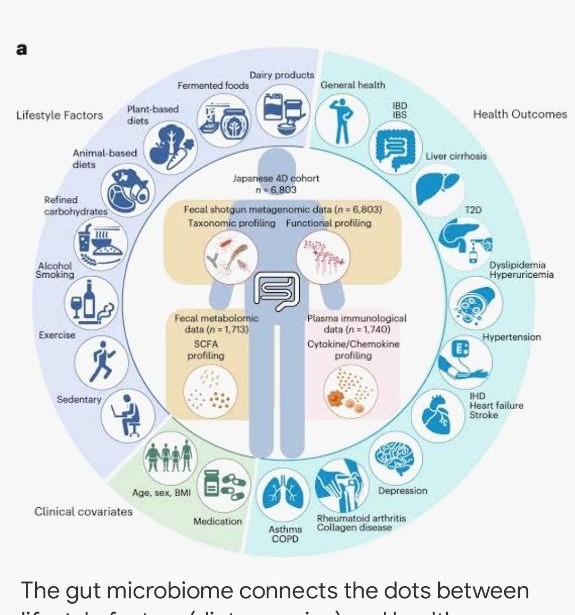
Scientific overview from Nature Medicine: The gut microbiome serves as the central biological hub connecting modifiable lifestyle factors to health and disease.
For decades, medicine understood that lifestyle choices: what we eat, how much we move, and whether we sit for hours: directly dictate long term health. Yet the precise molecular bridge connecting a bowl of lentils or an afternoon walk to lower rates of cardiovascular disease, depression, and diabetes remained partially obscured in biological complexity.
Now, a landmark scientific investigation published in Nature Medicine has decisively connected the dots. Drawing on deep fecal shotgun metagenomic sequencing from 6,803 adult participants in the Japanese 4D cohort (Disease, Drug, Diet, Daily life), an international research consortium has proven that the gut microbiome functions as the primary mediator translating daily lifestyle habits into physical vitality or chronic disease.
When evaluated through the salutogenic philosophy of OmOrenda, this study offers profound vindication for holistic living: demonstrating that human wellbeing is an ecological partnership between human choices and the trillions of microbial beings sharing our bodies.
The Nature Medicine Study: 6,803 Metagenomes Unpack the Gut
Led by Dr. Naoyoshi Nagata and colleagues, and highlighted by world renowned physician scientist Dr. Eric Topol, the study represents one of the largest and most rigorously controlled multi omics investigations ever conducted. The researchers integrated four comprehensive data streams:
- Fecal Shotgun Metagenomics (n = 6,803): High depth sequencing identifying exact bacterial species, taxonomic profiles, and metabolic functional genes.
- Fecal Metabolomics (n = 1,713): Direct profiling of short chain fatty acids (SCFAs), including acetate, propionate, and butyrate.
- Plasma Immunological Profiling (n = 1,740): Measuring circulating cytokines and chemokines to quantify systemic inflammation.
- Clinical Health Outcomes across 15 Diseases: Tracking inflammatory bowel disease, irritable bowel syndrome, liver cirrhosis, type 2 diabetes, dyslipidemia, hypertension, heart failure, stroke, depression, rheumatoid arthritis, asthma, and COPD.
To confirm that these findings were not culturally confined to Japan, the team validated their machine learning prediction scores across thirteen independent international cohorts comprising over three thousand individuals across the United States, China, Sweden, Russia, and Australia.
The Discovery of Two Opposing Microbiome Axes
The central revelation of the study is the existence of two diametrically opposing microbiome mediated axes that govern human health:
The Health Associated Axis
Powered by plant based foods, soy, fermented dairy, and regular exercise
- Enriched in beneficial dietary fiber metabolizing bacteria
- Elevates short chain fatty acids, specifically anti inflammatory butyrate
- Downregulates circulating systemic inflammatory cytokines
- Protects against metabolic syndrome, cardiovascular decline, and depression
The Disease Associated Axis
Driven by ultra processed carbohydrates, heavy animal fats, and sedentary living
- Enriched in oral derived bacteria and opportunistic pathobionts
- Accelerates microbial host glycan degradation and gut barrier breakdown
- Triggers systemic pro inflammatory cytokine cascades
- Directly mediates 15 chronic conditions, including hypertension, T2D, and IBD
1. The Health Associated Axis
Participants consuming diets rich in whole plant foods, traditional soy (such as miso, natto, and tofu), and fermented dairy demonstrated an enrichment of specialized microbial metabolic pathways. These bacteria excel at fermenting complex dietary fibers into short chain fatty acids, most notably butyrate.
Butyrate acts as a master epigenetic regulator: it fuels the colonic epithelial lining, seals tight junctions to prevent gut leakiness, and triggers an anti inflammatory immunological profile in peripheral blood, dramatically lowering the risk of metabolic syndrome and vascular disease.
2. The Disease Associated Axis
In contrast, individuals consuming refined carbohydrates and leading sedentary lives fostered an entirely different microbial ecosystem. Their guts were invaded by oral derived bacteria and opportunistic pathobionts that normally inhabit the mouth or linger in dysbiotic states.
Deprived of nourishing dietary plant fibers, these pathobionts begin degrading the protective mucosal layer of the intestine (microbial host glycan utilization). This degradation exposes the gut wall, triggering elevated systemic pro inflammatory cytokines and directly mediating the onset of fifteen major chronic diseases.
Surprising Insights: The Nuance of Fermentation and Alcohol
The granular resolution of shotgun metagenomics also yielded surprising physiological subtleties:
- Starter Cultures vs. Resident Commensals: Interestingly, the transient starter culture microbes present in fermented foods (such as yogurt or packaged fermented products) did not directly mediate long term health effects on their own. Instead, fermented foods nourish and fortify the indigenous, resident gut bacteria, empowering the native microbiome to thrive.
- The Dual Action of Alcohol: Alcohol consumption displayed complex, paradoxical mediation patterns: interacting with microbial host glycan utilization in ways that varied depending on overall dietary fiber background and dosage.
The OmOrenda Perspective: Internal Ecology as Planetary Flourishing
The findings of this historic study harmonize seamlessly with the foundational pillars of the OmOrenda philosophy:
The Living Web of Om (Inner Interconnectedness)
In Eastern contemplative traditions, Om represents the sacred unity of all creation. We often imagine ourselves as solitary, autonomous individuals. Yet the Japanese 4D cohort reminds us that we are holobionts: walking ecosystems comprising human cells and trillions of microbial symbiotic partners. What we feed ourselves, we feed to our microbial companions. When we cultivate stillness, choose plant based whole foods, and honor daily movement, we create an internal climate of peace and cellular harmony.
The Protective Responsibility of Orenda
Orenda embodies the active, spiritual energy that empowers beings to heal, nourish, and protect life. In Indigenous Haudenosaunee wisdom, leadership is evaluated through the welfare of the next seven generations. Our gut microbiome requires this exact stewardship. By steering clear of ultra processed carbohydrates, nourishing our gut soil with plant diversity, and protecting our internal biome, we practice embodied Orenda: ensuring that our physical vessels remain vibrant, resilient sanctuaries for purposeful action.
Salutogenic Architecture: From Soil to Gut to Soul
At OmOrenda, whether designing biophilic timber sanctuaries like the Chhauni Tree House in Nepal or preparing nourishing kitchen table meals, we recognize that healthy soil, healthy food, and a healthy gut microbiome are one continuous thread. Healing our planetary ecology begins by healing our internal biological terrain.
Actionable Habits for Cultivating a Flourishing Microbiome
- Embrace Diverse Plant Fibers: Incorporate at least thirty different plant species weekly, including legumes, leafy greens, seeds, and root vegetables to fuel butyrate producing bacteria.
- Integrate Fermented Staples: Consume traditional fermented foods like miso, tempeh, natto, and cultured kefir to stimulate resident commensal diversity.
- Minimize Refined Carbohydrates: Eliminate ultra processed sugars and refined flours that feed invasive oral pathobionts and trigger mucosal erosion.
- Move Daily: Engage in regular brisk walking, forest bathing, or yoga: physical movement directly stimulates gut motility and prevents microbial stagnation.
References and Sources
- Nagata, N., Wei, R., Kaneko, G., et al. (2026). Opposing microbiome mediated axes link modifiable lifestyles to health and chronic diseases. Nature Medicine, Published November 5, 2026. DOI: 10.1038/s41591 026 04744 5.
- Eric Topol, MD, Fecal Shotgun Metagenomics and Multi Omics Lifestyle Mediation Analysis, Scripps Research.
- Japanese 4D Microbiome Project (Disease, Drug, Diet, Daily life Cohort), National Center for Global Health and Medicine, Tokyo, Japan.