

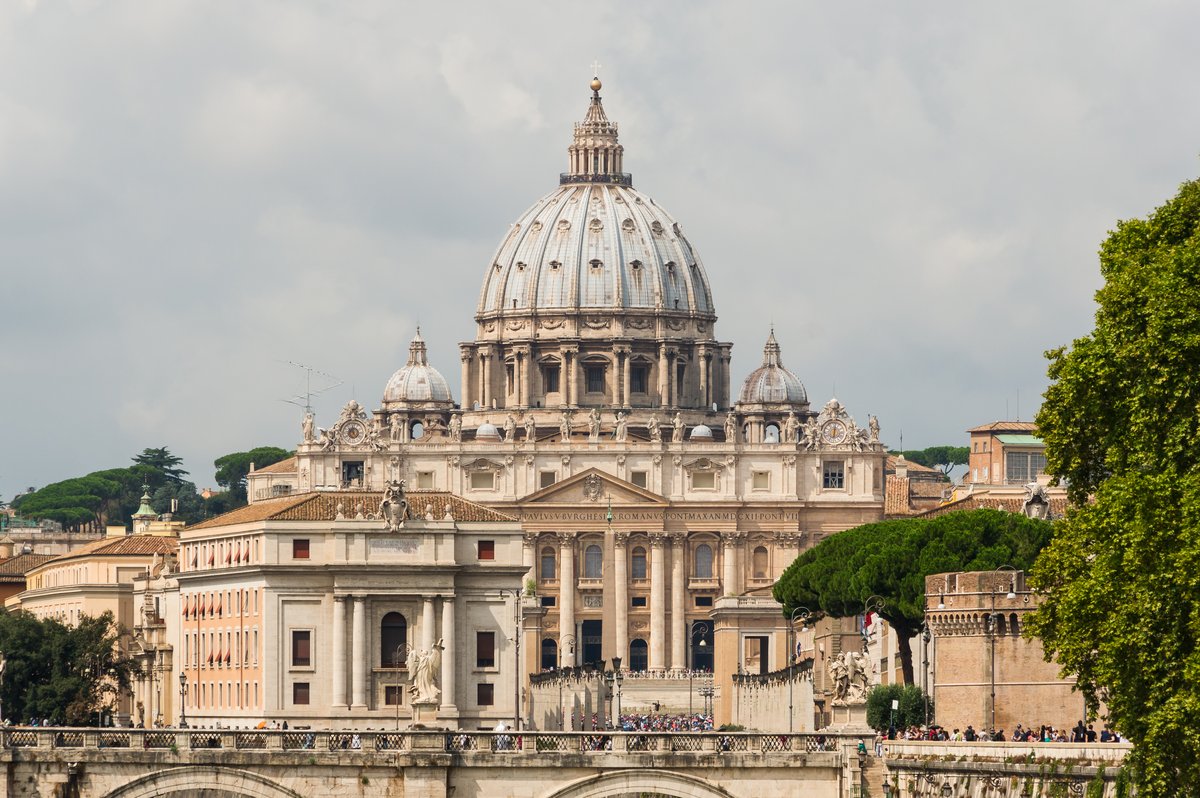
Photo by Jebulon on Wikimedia Commons (CC0): Saint Peter’s Basilica, Vatican City: a global forum reminding humanity that technological power must serve the sacred dignity of the human person.
In a world increasingly hypnotized by the velocity of artificial intelligence, a profound moral declaration has resonated from the Vatican. Addressing scientists, philosophers, and technologists gathered for a historic dialogue organized by the Pontifical Academy for Life and the Future of Life Institute, the Papal address delivered an unyielding ethical boundary: decisions affecting human life, freedom, and the use of force must never be delegated to machines.
Reaffirming the foundational appeals delivered to G7 world leaders, the Vatican issued an urgent warning against reducing human beings to statistical data points, algorithmic targets, or border control calculations. When examined in the light of the OmOrenda philosophy, this message strikes at the very heart of how humanity must navigate the machine age. True flourishing can never be engineered through automated detachment; it requires contemplative stillness, active moral courage, and an absolute reverence for the sacred web of life.
The Five Considerations for Artificial Intelligence
Drawing from the encyclical Magnifica Humanitas, the Papal address articulated five foundational pillars to govern the emergence of synthetic intelligence:
1. Open Future
AI trajectories are not predetermined; human moral choice dictates purpose and boundaries.
2. Tools, Not Persons
Machines lack somatic feeling, grief, and love; personhood must never obscure human accountability.
3. Non Delegable Choice
Life, freedom, and force must never be reduced to algorithmic calculation or targeting code.
4. Common Good
Technological progress must nourish all humanity equally rather than enrich an elite few.
5. Ethical Governance
Independent oversight, international treaties, and complete bans on autonomous weapons.
1. The Future of AI Is Not Predetermined
Technological fatalism is an illusion. Machine intelligence does not possess an autonomous destiny separate from human agency. Because humans design, train, and fund these architectures, humanity retains the absolute responsibility to guide, correct, and when necessary, outright reject harmful applications. The essential question facing innovators is not simply “What can AI do?”, but “What noble purpose must it serve?”
2. Machines Are Tools, Not Persons
A machine has no biological body, feels no grief, experiences no joy, and understands neither love nor reciprocal obligation. The Papal address cautioned against premature proposals to grant synthetic systems legal personhood. Conferring rights onto algorithms creates a dangerous legal fiction that obscures human accountability, leaving wounded human beings to seek justice from faceless, unfeeling mathematical code.
3. Decisions Over Life Cannot Be Delegated
Placing an individual into an algorithmic targeting database or automated detention queue strips away their humanity, transforming a living soul into a disposable variable. Decisions regarding human survival, liberty, and the deployment of lethal force must remain strictly bounded by informed, empathetic human oversight. The address renewed the moral demand to disarm artificial intelligence and establish an immediate international ban on lethal autonomous weapons systems.
4. Intelligent Technologies Must Serve the Common Good
Technological advancement must never become an insular playground for corporate monopolies or a geopolitical weapon for elite dominance. AI must foster genuine solidarity, ensuring that life enhancing tools, medical breakthroughs, and ecological restoration are distributed equitably across the global human family.
5. Institutions Must Put Ethics into Binding Practice
Vague corporate codes of conduct are insufficient barriers against systemic overreach. The international community requires robust institutions, binding standards, independent technical audits, and transparent mechanisms of legal accountability to evaluate AI deployments and provide swift restitution for harm.
Contrasting Two Visions of the Future
The OmOrenda Way: Grounding the Machine in Stillness and Agency
The Vatican’s call for ethical boundaries resonates deeply with the foundational philosophy of OmOrenda, which bridges Eastern contemplative wisdom with Indigenous Haudenosaunee stewardship:
The Contemplative Ground of Om (Interconnected Wholeness)
In Eastern contemplative philosophy, Om signifies the underlying, unbroken fabric of consciousness uniting all existence. When military and technocratic systems reduce people to digital coordinates, they commit an act of spiritual violence: severing the individual from the living whole.
Om teaches us that no algorithm can quantify the infinite depth of a human soul. Stepping into the stillness of Om allows engineers, founders, and policymakers to drop the feverish race for computational supremacy. In that quietude, we remember that technology is only valuable when it honors and deepens our shared humanity.
The Active Healing Force of Orenda (Seven Generation Care)
While Om provides spiritual grounding, Orenda calls for decisive ethical action. In Haudenosaunee tradition, Orenda is the spiritual life energy that empowers human beings to act as custodians and healers. Clan Mothers instructed leaders to measure every policy by its impact on the seventh generation into the future.
Delegating lethal decisions to an autonomous drone or outsourcing judicial sentencing to a predictive algorithm is an absolute abdication of Orenda. Ethical stewardship cannot be outsourced to silicon chips. Humans must bear the weight of moral choice, ensuring that artificial intelligence is parented with kindness, empathy, and reverence for future generations.
The Guardian Spirit of LeoChi
At OmOrenda, our mascot LeoChi, the Himalayan snow leopard, represents noble guardianship: watchful, tranquil, and fiercely protective of fragile ecosystems. LeoChi embodies the true role of technology: not an aggressive weapon seeking dominance, but a quiet, well bounded protector dedicated to safeguarding the vulnerable and fostering planetary flourishing.
A Universal Moral Call to Action
The Vatican’s declaration and the OmOrenda philosophy converge on a single, luminous truth: artificial intelligence must be a servant of life, never an arbiter of death.
As international diplomats gather in Geneva to negotiate treaties on autonomous weapons, civil society, spiritual leaders, and builders must unite around this non negotiable line. We must refuse to allow machines to decide who lives and who dies. By holding fast to human dignity, practicing contemplative stillness, and exercising seven generation responsibility, we can raise a technological future worthy of the human spirit.
References and Sources
- Vatican News, Pope on AI: Decisions affecting human life must never be delegated, Address to the Pontifical Academy for Life and Future of Life Institute, October 2026.
- Pope Francis, Address to the G7 Leaders on Artificial Intelligence, Borgo Egnazia, June 2024.
- Encyclical Letter, Magnifica Humanitas, Vatican City.
- Future of Life Institute, Global AI Ethics and Autonomous Weapons Governance.