


The elusive ‘Ghost of the Mountains’ (Panthera uncia). Photo on Unsplash (Open Source Stock).
Every year on October 23, the world marks International Snow Leopard Day—a global moment to celebrate the solitary, sacred big cat that reigns over the highest mountain peaks of Central and South Asia.
Known as the “Ghost of the Mountains,” the snow leopard (Panthera uncia) is an apex predator and vital ecological keystone of the Third Pole. Yet across its rugged home range, the species faces mounting pressures from climate change, shrinking alpine habitats, declining wild prey, and human-wildlife conflict with mountain pastoralists.
As recent reporting from Mongabay reveals, the tide is turning. Groundbreaking field science, multi-million-acre climate corridors, and community-centered conservation are proving that humans and snow leopards can not only coexist—they can thrive together.
1. The Science of Coexistence in Nepal’s Lapchi Valley
In Nepal, a landmark 2025 government wildlife census estimated that approximately 397 snow leopards roam the country’s high Himalayan ranges. But how do these apex predators share the mountain ridges with other carnivores and human communities?
A recent study led by researcher Narayan Prasad Koju in Nepal’s remote Lapchi Valley uncovered a remarkable multi-predator dynamic: snow leopards, common leopards (Panthera pardus), and Himalayan wolves (Canis lupus chanco) share the exact same rugged terrain by partitioning their prey.
The Critical Prey Keystone:
The research revealed that wild blue sheep (bharal / Pseudois nayaur) comprise nearly 50% of the snow leopard’s diet. Maintaining healthy wild ungulate populations is the single most important factor in preventing carnivores from preying on domestic yaks and sheep.
“When wild prey declines, all three predators shift toward domestic livestock, which triggers retaliatory killings and destabilizes the whole mountain ecosystem,” explained lead researcher Narayan Prasad Koju.
2. Centering the Herders: The Rodney Jackson Doctrine
For decades, conservation initiatives focused heavily on tracking and counting snow leopards. But according to Dr. Rodney Jackson, legendary biologist and founder of the U.S.-based Snow Leopard Conservancy, true conservation must focus on the human families living alongside the cats.
- Sharing the Economic Burden: Mountain pastoralists bear the direct financial loss when a snow leopard enters a corral. Without compensation or protection, retaliatory measures often follow.
- Smart Tech & Corrals: Conservation is shifting toward practical deterrents: reinforced solar-lit predator-proof corrals, smart camera-trap alert systems that notify herders when predators approach grazing pastures, and rapid community-managed livestock relief funds.
3. Climate-Ready Roaming: Kyrgyzstan’s 2-Million-Acre Corridor
In Central Asia, climate resilience has moved from theory to geography. In central Kyrgyzstan, the government and local partners, alongside the U.N. Environment Programme (UNEP), established the Ak Ilbirs Ecological Corridor.
Spanning roughly 800,000 hectares (nearly 2 million acres), the corridor protects habitat for an estimated 300 snow leopards. Crucially, the corridor was designed using climate models projecting through 2070, ensuring high-altitude migratory pathways remain contiguous as warming temperatures push alpine tree lines higher, while sustainably integrating traditional seasonal grazing for pastoralist families.
4. LeoChi: The Spiritual Guardian of OmOrenda
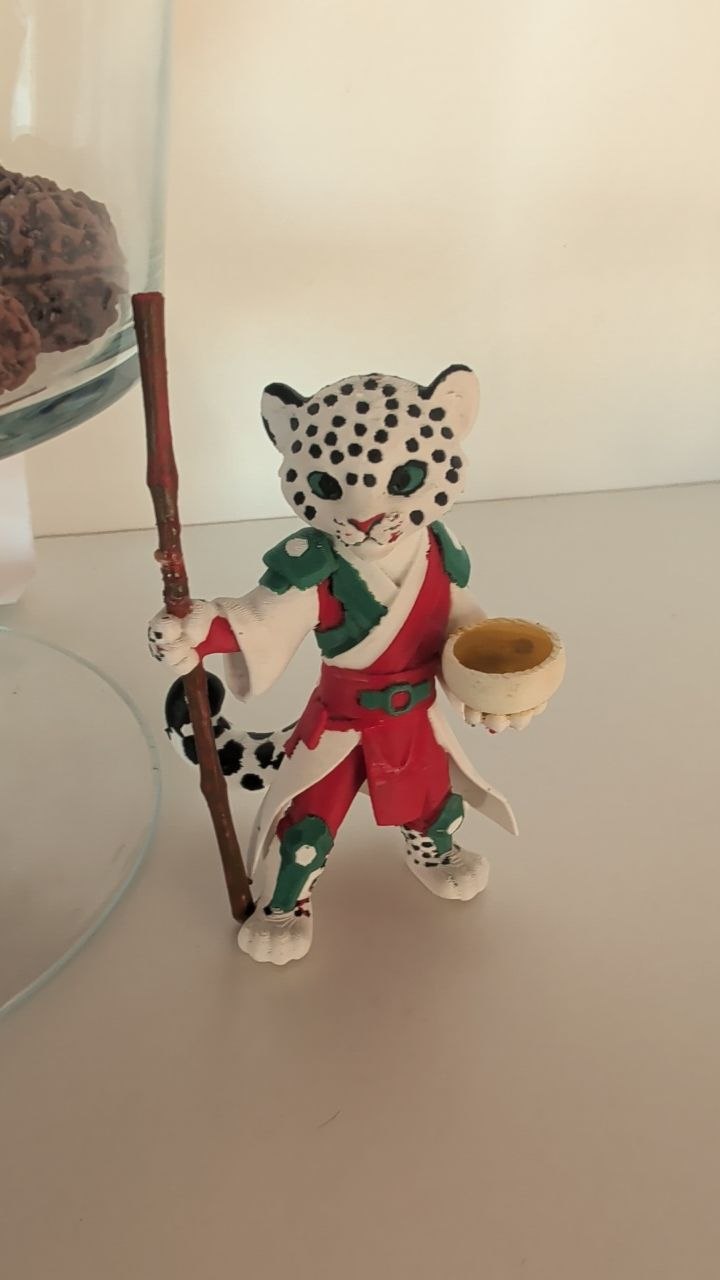
A 3D printing of LeoChi, the snow leopard spirit guardian who originates from the high Himalayas of Nepal and now lives in the San Francisco Bay Area at OmOrenda.space.
At OmOrenda.space, the snow leopard is far more than a distant wildlife species—it is our guiding cultural spirit, embodied by LeoChi.
Originally from the sacred high peaks of the Himalayas in Nepal, LeoChi journeyed across continents to make his home in the San Francisco Bay Area at OmOrenda.space. Standing in the heart of Silicon Valley, he acts as a living bridge between ancient contemplative mountain stillness and the future of human flourishing:
- The Staff (Taming the Sympathetic Nervous System): The walking stick in LeoChi’s right hand represents controlling the sympathetic nervous system. It is a constant somatic reminder to not be driven by fear, stress, or fight-or-flight reactivity. The staff assures him that he is safe and protected, allowing his nervous system to rest in grounded equanimity.
- The Singing Bowl (Harmonic Resonance): In his left hand, the golden singing bowl rings out the primordial vibration of Om, recalibrating the human body and restoring peace to overstimulated minds.
- Embodying Om (Himalayan Stillness): Representing the quietude, pure air, and mental clarity born from the highest peaks of Nepal.
- Activating Orenda (The Power to Heal): Channeling our collective willpower to build well-bounded technology, salutogenic homes, and compassionate multi-species coexistence.
The Takeaway
World Snow Leopard Day reminds us that the preservation of wild places does not happen in isolation from human life. True conservation is an act of reciprocity—where science, traditional herding wisdom, modern deterrents, and spiritual reverence meet.
When we protect the snow leopard, we protect the high watersheds of the Himalayas, the livelihoods of mountain pastoralists, and the wild heart of our living Earth.
Source Article & References
- Mongabay Report: World Snow Leopard Day: Community action and new science foster coexistence with humans by Naina Rao (Oct 23, 2026).
- Field Studies: Lapchi Valley Carnivore Partitioning Study by Narayan Prasad Koju; Snow Leopard Conservancy (Dr. Rodney Jackson).
- Habitat Initiative: UNEP Central Asian Mammals and Climate Adaptation Project (Ak Ilbirs Ecological Corridor, Kyrgyzstan).
- OmOrenda Movement: The Legend of LeoChi on OmOrenda.space.