

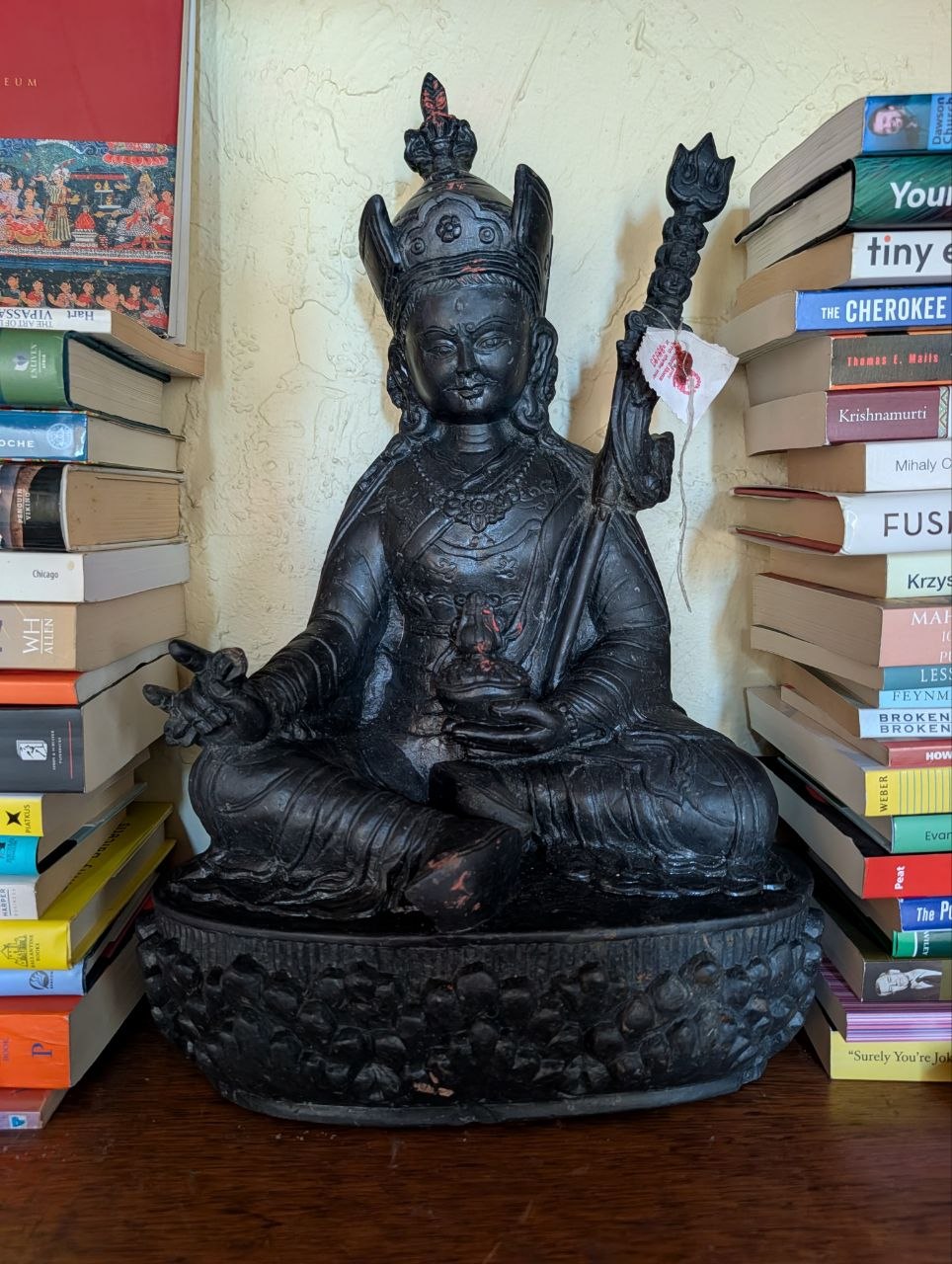
The sacred statue of Guru Padmasambhava, hand-carved from volcanic basalt stone sourced from Pharping, Nepal, by renowned master sculptor Subha Ratna Bajracharya of Patan.
In the high mountain valleys of Nepal, sacred sculpture is far more than an artistic pursuit—it is a spiritual practice of listening to the living earth. When master artisans shape sacred icons and spiritual masters, their most revered medium has remained unchanged for centuries: black volcanic basalt stone.
The extraordinary statue of Guru Padmasambhava (Guru Rinpoche) at OmOrenda.space carries an incomparable lineage: it was hand-carved from solid basalt stone sourced directly from Pharping (Yangleshö), Nepal—the very sacred valley where Padmasambhava meditated and attained supreme realization in the 8th century—and sculpted by Subha Ratna Bajracharya, one of Nepal’s most celebrated master stone carvers from the historic city of Patan.
1. The Sacred Provenance: Basalt from Pharping, Nepal
In Himalayan history, few locations hold the spiritual gravity of Pharping. Nestled on the southern rim of the Kathmandu Valley, Pharping is revered as a second Bodh Gaya—the sanctified ground where Guru Padmasambhava spent years in deep retreat within the sacred Asura Cave and Yangleshö Cave, overcoming obstacles and anchoring the Vajrayana lineage in the Himalayas.
To carve a likeness of the Lotus-Born Guru from the very geological basalt strata of Pharping itself creates an unbroken physical and energetic link between the land of his meditation and the sculpture itself. The stone does not merely represent Padmasambhava; it is born from the mountain where he breathed, meditated, and attained enlightenment.
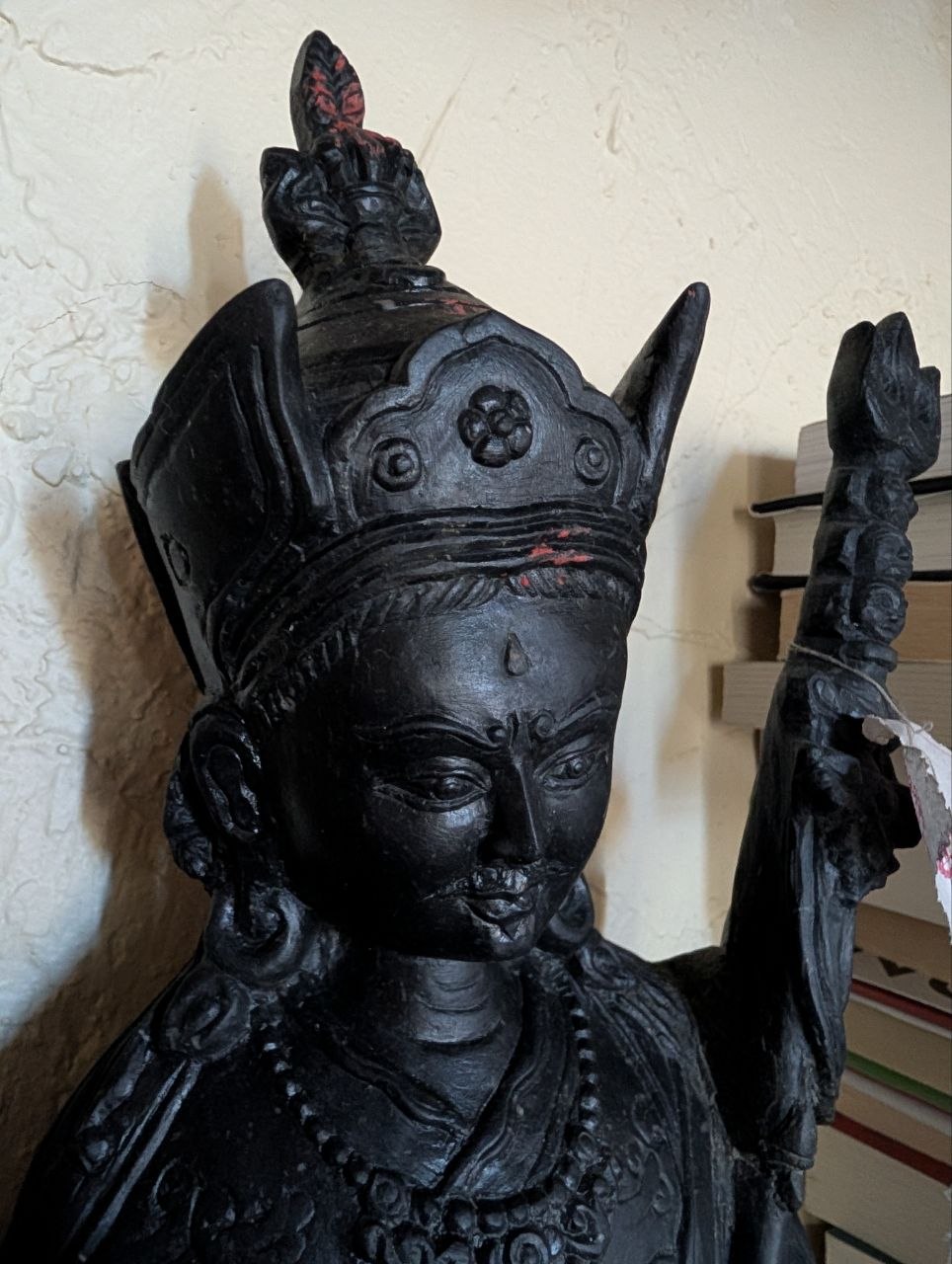
Detail of Guru Padmasambhava’s visage: The Lotus Crown (Pema Thongdrol), third-eye mark, and serene meditative gaze, chiseled with microscopic precision in solid basalt.
2. Master Sculptor Subha Ratna Bajracharya of Patan
The city of Patan (Lalitpur) is the historic epicenter of traditional Newar craftsmanship, whose artists have sculpted the sacred temples, courtyards, and palace squares of the Kathmandu Valley for over a thousand years.
Subha Ratna Bajracharya is recognized as a living treasure among Patan’s stone carvers. Sculpting black basalt—one of the densest, hardest volcanic rocks on Earth—demands decades of mastery, specialized tempered chisels, and deep meditation on the iconographic proportions (Iconometry / Pratima Laksana).
Attached to the sacred Khatvanga staff of the statue is an official red wax-sealed clearance tag from the Department of Archaeology of Nepal (पुरातत्व विभाग), certifying this statue as an authentic, high-mastery contemporary cultural treasure created by a licensed Nepali master.
3. Why Basalt Is the King of Himalayan Carving Stones
While softer stones like limestone or soapstone can be carved quickly, basalt possesses distinct geological properties that have made it the choice of kings and lamas for millennia:
- Extreme Micro-Density & Crisp Linearity: Basalt’s fine-grained volcanic matrix allows the carver to execute microscopic details—such as the delicate strands of hair, the beaded mala necklace, and the intricate lotus petals of the base—without fear of fracturing.
- Eternal Weather Resistance: Non-porous and virtually impervious to water, temperature shocks, and humidity, basalt sculptures withstand centuries without weathering or structural loss.
- Grounding Matte Charcoal & Lustrous Black Luster: Hand-finished basalt carries a deep, grounding tactile resonance that naturally calms the human nervous system.
4. The Iconography of Guru Padmasambhava
Every element sculpted by Subha Ratna Bajracharya holds profound symbolic meaning:
The Sacred Implements of the Statue:
- The Lotus Hat (Pema Thongdrol): Signifying complete spiritual liberation upon sight, adorned with the sun and moon and topped with a vajra.
- The Vajra (Dorje) in the Right Hand: Held at the heart, symbolizing diamond-like indestructible clarity, truth, and the subduing of inner ego.
- The Kapala & Longevity Vase (Left Hand): Resting in the lap of meditative equanimity, holding the skull-cup containing the nectar of wisdom and the vase of boundless life (*Tsepbum*).
- The Khatvanga Staff: Resting in the crook of the left arm, representing the union of wisdom and compassionate skillful action.
5. The Sacred Intersection with OmOrenda.space
At OmOrenda.space, the presence of this sacred Pharping basalt statue serves as a profound energetic and cultural anchor:
- Om (The Grounded Stillness of Meditation): Embodying the timeless silence of the caves of Pharping, grounding modern living in ancestral mindfulness and nervous system tranquility.
- Orenda (Active Willpower to Heal): Reflecting the fearless compassionate agency of Guru Padmasambhava, who journeyed across mountains to harmonize turbulent lands and uplift human consciousness.
Flanked by wisdom texts spanning modern physics, philosophy, and contemplative traditions, the statue stands as a bridge between the ancient geology of the Himalayas and the future of human flourishing.
References & Cultural Lineage
- Master Sculptor: Subha Ratna Bajracharya, Patan (Lalitpur), Nepal.
- Geological Provenance: Pharping (Yangleshö), Kathmandu Valley, Nepal.
- Certification: Department of Archaeology, Government of Nepal (पुरातत्व विभाग).
- The OmOrenda Vision: Grounding Innovation in Living Nature and Ancestral Wisdom.
