

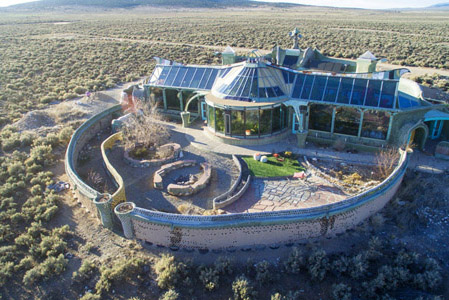
In the high desert of New Mexico, where rainfall is scarce and temperatures swing between extremes, a cluster of otherworldly homes appears to grow naturally out of the terrain. Half-buried in earth and lined with slanted glass, these structures are known as Earthships—self-sufficient dwellings designed to operate entirely off-grid. They generate their own power, harvest their own water, and regulate an internal climate without relying on conventional infrastructure.
What exactly is an Earthship?
At its simplest, an Earthship is a home designed to function independently of public utilities. Conceived in the 1970s by American architect Michael Reynolds, the concept emerged as a response to growing concerns over waste and housing. Reynolds experimented with discarded materials—from cans and bottles to earth-packed tires—to create buildings that operate in harmony with nature rather than against it.
For much of its early history, building with waste materials was widely dismissed as a countercultural experiment. But as Reynolds explains, the ultimate aim is deeply human: to create a building that provides everything a person needs to live using only what is available from the local environment.
How the Closed-Loop System Works
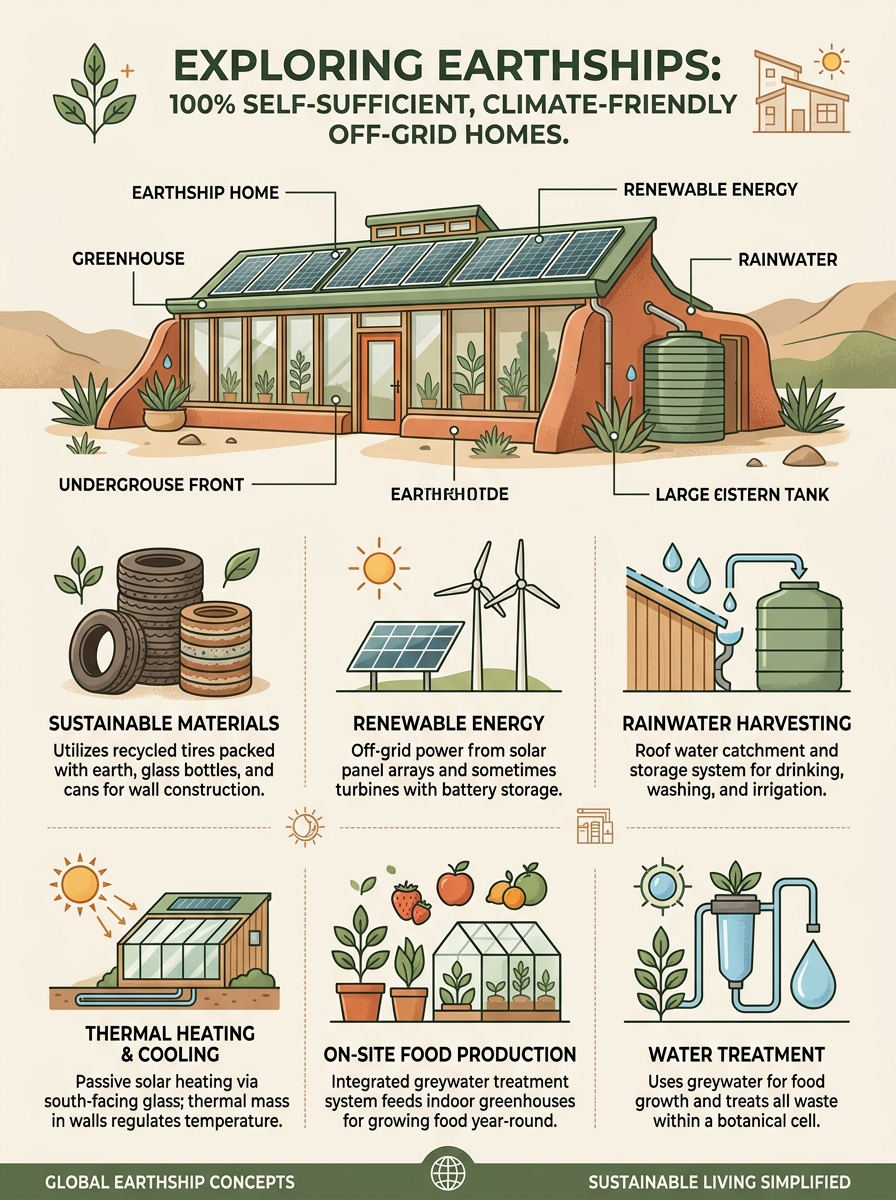
Rather than layering smart technologies onto a conventional structure, the entire Earthship is conceived as a closed-loop system where little is wasted and much is reused. It is built around six integrated functions:
- Heating and Cooling: The building captures sunlight through slanted glass, while thick earth-packed walls (often made of recycled tires) store and release heat to keep temperatures remarkably stable year-round.
- Energy: Solar panels—and sometimes wind turbines—generate all the electricity the home needs.
- Water: Rainwater is collected from the roof, filtered, and used for drinking and bathing.
- Food: Indoor planting beds create a lush greenhouse environment, allowing crops to grow regardless of external seasons.
- Waste: “Greywater” from sinks and showers is treated on-site and routed to water the indoor plants, before eventually being used to flush toilets.
- Materials: The structure repurposes reclaimed materials, transforming discarded items like tires, bottles, and cans into incredibly durable and beautiful building elements.
From Fringe Experiment to Climate Solution
In the early days, Earthships were often ridiculed as “hippie housing.” Today, the perception has completely shifted. As environmental pressures like energy instability, water scarcity, and extreme weather intensify, the Earthship model has transformed from a speculative project into a pragmatic luxury solution.
Modern Earthships aren’t just about survival; they are about extreme comfort and resilience. Interiors are bright, layered, and feature amenities like high-speed internet, fully equipped kitchens, and indoor banana trees. The concept has now scaled globally, with variations adapted for the freezing winters of Canada to the arid deserts of the Middle East.
While they may not be a universal solution for every urban setting, Earthships offer a compelling preview of what the future of housing must look like: resilient, independent, and completely integrated with the natural world.