
Phenomenology: The Philosophy of Pure Experience
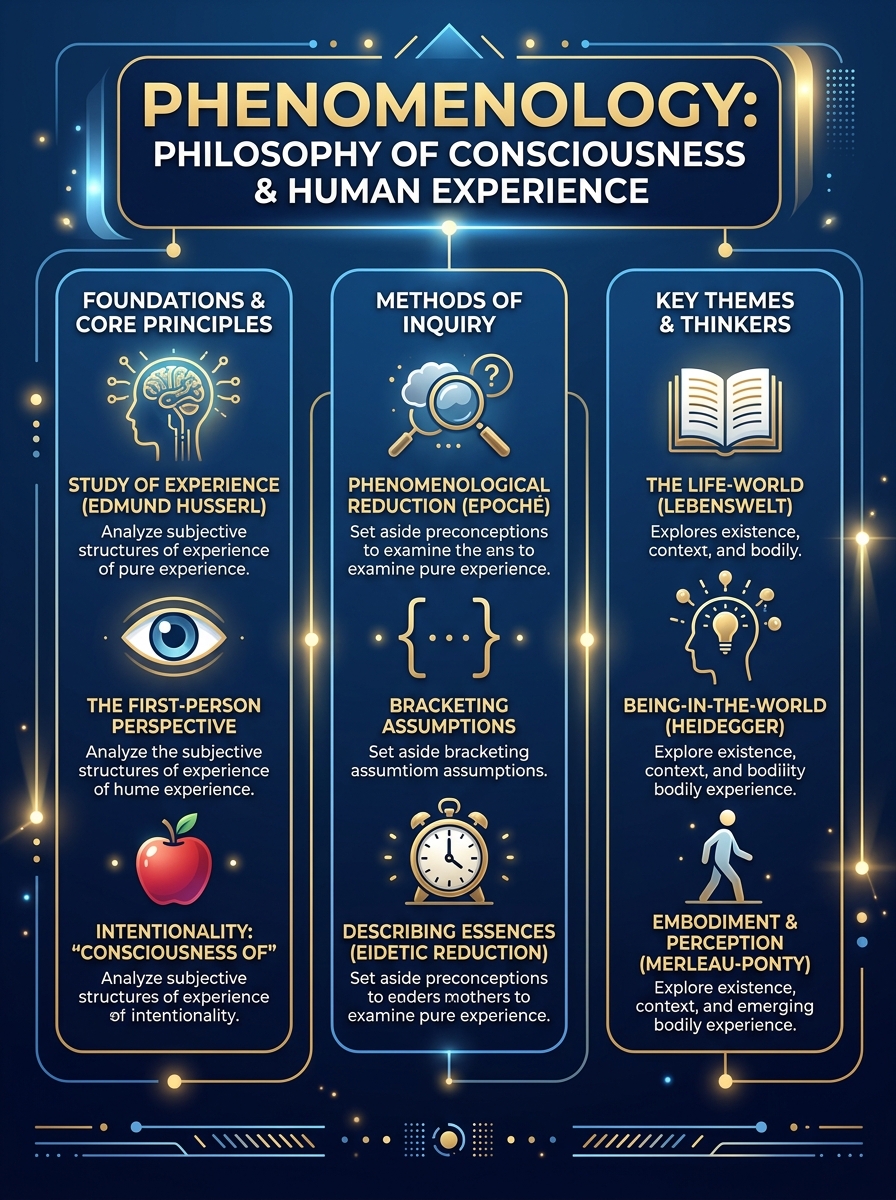
At its core, phenomenology is a philosophical movement that asks a deceptively simple question: What is it actually like to experience something? Instead of looking at the world through the lens of objective science, psychology, or preconceived theories, phenomenology focuses entirely on human consciousness from the first-person perspective. It tackles everything from the profound (the experience of grief or time) to the mundane (the experience of sipping a warm cup of coffee).
Here is a breakdown of how it works, its core concepts, and why it matters.
The Core Concept: First-Person Experience
Imagine you are looking at a red apple.
A scientist might explain the apple by talking about light wavelengths, optical nerves, and cellular structures.
A phenomenologist doesn’t care about the molecules. They care about your unique experience of the apple: the vividness of the red, the memory of hunger it triggers, the weight of it in your hand, and the immediate feeling of anticipation.
Phenomenology argues that our primary reality is not the objective world of science, but the lived world (Lebenswelt) we experience every day.
3 Pillars of Phenomenological Thinking
To understand how phenomenologists study the mind, it helps to look at their three foundational concepts:
- Intentionality: In everyday speech, “intentional” means you did something on purpose. In phenomenology, intentionality means that consciousness is always conscious of something. Your mind is never just a blank slate; it is always directed toward an object—whether that object is a physical chair, a memory, a feeling, or a mathematical equation.
- The Epoché (Bracketing): To get to the pure essence of an experience, you have to strip away your biases, scientific theories, and cultural assumptions. The founder of phenomenology, Edmund Husserl, called this the Epoché (or “bracketing”).
Example: If you want to phenomenologically analyze “fear,” you must bracket out what psychology textbooks say about adrenaline or evolution, and instead focus purely on how fear feels as it floods your immediate awareness. - Eidetic Reduction: Once you’ve bracketed your assumptions, you try to find the essence of the experience. What makes a specific experience what it is? If you changed certain details, would it still be the same experience? This helps philosophers separate the accidental details of a moment from its core structure.
The Big Names in Phenomenology
The movement evolved significantly through the 20th century, moving from pure logic to deep existentialism:
| Philosopher | Key Focus | Their Big Idea |
|---|---|---|
| Edmund Husserl (The Founder) |
Pure Consciousness | Wanted to make philosophy a “rigorous science” by studying the universal structures of the mind. |
| Martin Heidegger (The Existentialist) |
Dasein (Being-there) | Shifted focus from abstract consciousness to how we exist practically in the world. We are always “thrown” into a reality we didn’t choose. |
| Maurice Merleau-Ponty (The Body) |
Embodiment | Argued that we don’t just possess a body; we are our bodies. Our physical form shapes how we perceive everything. |
| Jean-Paul Sartre (The Freedom Thinker) |
Radical Freedom | Built upon phenomenology to argue that consciousness creates total freedom. “Existence precedes essence”—we define our own meaning through our choices and actions. |
Why Does It Matter Today?
Phenomenology isn’t just for dusty library shelves. It heavily influences several modern fields:
- Qualitative Research: In psychology, sociology, and nursing, researchers use phenomenological interviews to understand the lived experiences of patients, such as what it truly feels like to live with a chronic illness.
- Artificial Intelligence: It pushes back against the idea that the human mind is just a computer. Phenomenologists argue that true understanding requires a physical body interacting with a physical world.
- User Experience (UX) Design: Good design is rooted in understanding the seamless, intuitive flow of a user experiencing a product for the first time.
Phenomenology is a massive, rich branch of philosophy. Are you looking at this from a specific angle—like preparing for a philosophy class, researching a qualitative study, or just exploring existentialism?